

The book
Chapter 6: Purge, Unify, Simplify: The Art of Continuous Free Flow
Three practical movements that join the laboratory bench, the kitchen sink, and the quiet heart.
6.1 The Editorial Act Upon a Life: From Field Theory to Daily Discipline
We have traveled a long curve together across the nested manifold of this treatise. We began on the coastal cliffs of California in 1978, diagnosing the spiritual schizophrenia that tricks intelligent men and women into believing that paying the bills (saṃvṛti-satya) and holding the universe concise (paramārtha-satya) belong to rival, mutually destructive worlds.
In Chapter 1, through the second-century Madhyamaka dialectic of Nāgārjuna and the twentieth-century cybernetics of W. Ross Ashby, Gregory Bateson, Francisco Varela, and Ilya Prigogine, we discovered that the commercial invoice, the attention brought to the invoice, and the person signing the invoice are one undivided dependent occasion. Commercial effectiveness describes how that occasion functions within the causal network; emptiness (śūnyatā) describes its complete lack of an isolated, self-established essence (svabhāva).
In Chapter 2, we constructed the differential geometry and resistive magnetohydrodynamics of the supertoroid, demonstrating how a circulating field requires both a longitudinal toroidal revolution around the major axis () and an inward poloidal turn around the minor cross-section () to maintain a stable helical pitch (), how sustained operation in a resistive universe requires an honest energy budget (), and how an auxiliary recurrent process can be superinserted into a primary workflow to regenerate what the work consumes.
Across Chapters 3, 4, and 5, we watched those abstract equations acquire boots, calluses, ballpoint ink, and spectacles in the four parables of our itinerant chemist:
1. In the concrete drainage culverts of 1972 and across the floor of a West Texas garage, he discovered that surrender does not mean floating above human arrangements on a cloud of cosmic entitlement; it means recognizing how little of one’s existence belongs to oneself alone, and picking up the push-broom to participate in the extended circuit of reciprocal care.
2. In the desert highway motel room of 1975, sketching a cell-free enzymatic cascade with a superinserted cofactor regeneration loop, he learned that visionary inspiration from the bindu becomes genuinely useful only when we cross out the arrogant word COMPLETE and add a second column specifying what empirical evidence would disprove each step.
3. In the corporate flavor laboratory and at his own dining table, he learned how fifteen minutes of quiet sitting on a storeroom crate can clear the defensive static of the ego so that a scientist can read line one of a technician’s mixing log—and how a well-calibrated social faceplate serves as a compassionate impedance-matching ring, provided we notice when the mask sticks at the end of the day.
Now we stand at the threshold of the practical workshop. When the book is closed and Monday morning arrives, how does a practitioner actually regulate this multi-scale life over the span of ten, twenty, or forty years without letting the field tear itself apart?
Recall the three words pinned on a three-by-five index card above our chemist’s home desk at the close of Chapter 5: PURGE, MARRY, SIMPLIFY—or, in the formal systems nomenclature of our title, PURGE, UNIFY, SIMPLIFY. These three imperatives do not describe a one-time dramatic conversion experience; they describe a recurring editorial act upon a human life: release what is needless, join what has been artificially divided, and make the resulting commitments easier to enact.
Let us examine each of the three movements in full physical, cybernetic, and contemplative detail.
6.2 Phase I: PURGE — Constrained Relaxation and the Shedding of Phantom Loops
What is the primary cause of exhaustion in a gifted, multi-faceted human being? It is almost never the caloric or cognitive cost of the one task his hands are actually performing at ten o’clock on Tuesday morning. What exhausts the organism is the parasitic drag of fifty uncompleted, unexamined, or dishonest commitments running concurrently in the background.
Let us return to J. B. Taylor’s 1974 paper in Physical Review Letters, "Relaxation of Toroidal Plasma and Generation of Reverse Magnetic Fields". Recall from Chapter 2 that when a toroidal plasma is initially struck by a high-voltage discharge, it is filled with violent, tangled local eddies and sharp current gradients. Its total stored magnetic energy:
is far above the minimum required by its global topology. That excess energy does not contribute to stable confinement; instead, it drives local kinks, resistive tearing modes, and cross-field Lorentz forces () that hurl heat against the vessel wall.
When the plasma undergoes Taylor relaxation, finite resistivity allows those tangled local sub-surfaces to break and reconnect, burning off the excess turbulent energy until the field settles into the quiet, force-free state , while conserving the global magnetic helicity:
which represents the fundamental topological linkage of the system as a whole.
Now translate Taylor’s constrained relaxation directly into the operational discipline of PURGE.
In our chemist’s definition, to purge means to release unfinished obligations one has no honest intention or realistic capacity of completing, together with the internal courtroom commentary that defends them.
Open the desk drawers, filing cabinets, and mental ledgers of a hyper-divergent scientist or entrepreneur in 1978, and you will find three distinct classes of parasitic eddies that must be periodically purged:
1. The Purge of Phantom Obligations (Closing Open Loops): Because an imaginative mind sees possibilities everywhere, it is chronically tempted to say "Yes, I’ll look into that" or "Let’s start a project on that next month" to ten different colleagues, friends, and committees. Six months later, eight of those ten promises sit in the back of the notebook, unfulfilled. The practitioner has no honest intention of completing them, yet he lacks the courage to pick up the telephone or write a three-sentence note saying, "I overcommitted myself; I cannot take this on." Every time he walks past that colleague in the corridor, or every time he opens his drawer and sees the dusty file folder, a spike of resistive Ohmic heat () fires across his nervous system. To purge is to sit down on the first Sunday of every month with your single ledger, identify every open loop you are not genuinely going to build, and explicitly cancel, return, or close it. Here we must remember the honest physical caution we noted in Chapter 2: in Taylor relaxation, when fine-scale reconnection occurs, not every detailed local magnetic surface survives. Sometimes simplification alters or dissolves the very side-loops our vanity hoped to preserve forever. Let them go! A cancelled phantom promise restores more integrity to the global helicity than ten years of guilty procrastination.
2. The Purge of the Internal Defense Attorney (Holding the Universe Concise): Watch what the mind does while washing dishes or driving down the highway between appointments. Ninety percent of its metabolic expenditure () is spent drafting imaginary speeches: explaining to an invisible jury why the Wednesday afternoon batch failure wasn't really your fault, rehearsing how you will impress a gathering next autumn, or complaining silently about the bureaucratic stupidity of the accounting department. What does it mean to hold the universe concise? That phrase does not mean compressing the astronomical mass of the Virgo Cluster into your pineal gland, nor does it mean claiming cosmic omniscience. Holding the universe concise is a literary and practical name for relinquishing needless self-description. The chemist does not have to carry a grand metaphysical explanation of the whole cosmos inside his skull while balancing an account book; he can let the account book be the present task without making it the whole meaning of his existence. When you purge the compulsive internal commentator, the universe becomes instantly concise—a frying pan is just a frying pan in warm water, an assay is just an assay, and a mistake is just a data point asking for correction.
3. The Purge of Spiritual Ornamentation: Finally, the non-dual practitioner must purge the subtler temptation to decorate his ordinary work with esoteric jargon in order to feel special. Recall that when our chemist submitted his Friday report on the powdered food formulation, he did not write a single word about śūnyatā or toroidal flux. If a bridge timber is sound, you do not need to paint lotus petals on it to hold up the truck; if a chemical protocol is reproducible, you do not need to wrap it in Sanskrit to make it holy. Purging spiritual pretension leaves the bare, clean wood of honest craft.
6.3 Phase II: UNIFY (MARRY) — Aligning the Orthogonal Vectors ($\mathbf{J} \parallel \mathbf{B}$)
Once the parasitic local eddies have been purged, the practitioner enters the second operational movement: UNIFY—or, as our chemist wrote in his personal workbench shorthand, MARRY.
Why did he use the word marry? Because in human life, when two things are merely bolted together from the outside by force of contract, they chafe against each other at every turn; when they are married, they answer to a single shared household and a single shared life.
In the vector calculus of our supertoroid, what does it mean to marry the field? Look again at Taylor’s relaxed equilibrium state:
In an unrelaxed, divided life, the current vector (where you are pouring your daily hours, your muscular effort, and your speech) flows at an oblique or perpendicular angle to your primary field vector (your deepest contemplative clarity and your love for those in your care). The result is a continuous, tearing cross-field Lorentz force that rips the container apart. You sit at the laboratory bench wishing you were meditating on a mountain; you sit on the meditation cushion worrying about the laboratory; you sit at the dinner table with your companion while your mind is still defending a proposal in the conference room.
To marry (unify) the field means bringing the poloidal vector (, inward stillness and domestic care) and the toroidal vector (, outward technical and commercial service) into strict collinear alignment along the helical field line so that and the cross-field tearing force drops to zero.
In day-to-day conduct, this marriage rests upon three concrete commitments:
1. One Moral and Attentional Ledger Across All Rooms: The dualistic thinker keeps three separate moral ledgers. In his "Spiritual Ledger," he grades himself on how blissful and detached he felt during morning meditation. In his "Commercial Ledger," he allows himself to cut corners, exaggerate claims, or treat technicians harshly because "business is just a dirty game of māyā anyway." In his "Domestic Ledger," he expects his partner to tolerate his chronic tardiness and emotional distraction because "he is an exhausted visionary doing important work." To marry your life is to burn the three separate ledgers and keep one single book of accounts. How you speak to the warehouseman unloading maltodextrin drums, how carefully you code the blind tasting cups on Thursday morning, how honestly you bill the client on Friday afternoon, how attentively you listen to your companion over a sink full of soapy water on Friday night, and how quietly you sit before dawn on Saturday morning are all measured by the exact same standard of wakeful reciprocity.
2. Devotional Integration Without Sentimentality (Saundarya Laharī Verse 27): Here the Tantric insight of Śrī Vidyā joins hands with Nāgārjuna’s emptiness. As Verse 27 of the Saundarya Laharī taught us in Chapter 4, ordinary action does not have to be an interruption of contemplative practice; it can become the exact site of practice. When the chemist walks into the windowless storeroom for fifteen minutes on Wednesday afternoon, he is not escaping the laboratory—he is superinserting the poloidal turn () so that the laboratory work () can return to reality. And when he walks back out of the storeroom to read the technician’s mixing notes, he is not leaving contemplation behind—he is allowing quiet awareness (Śiva) to express itself through precise analytical discrimination (Śakti).
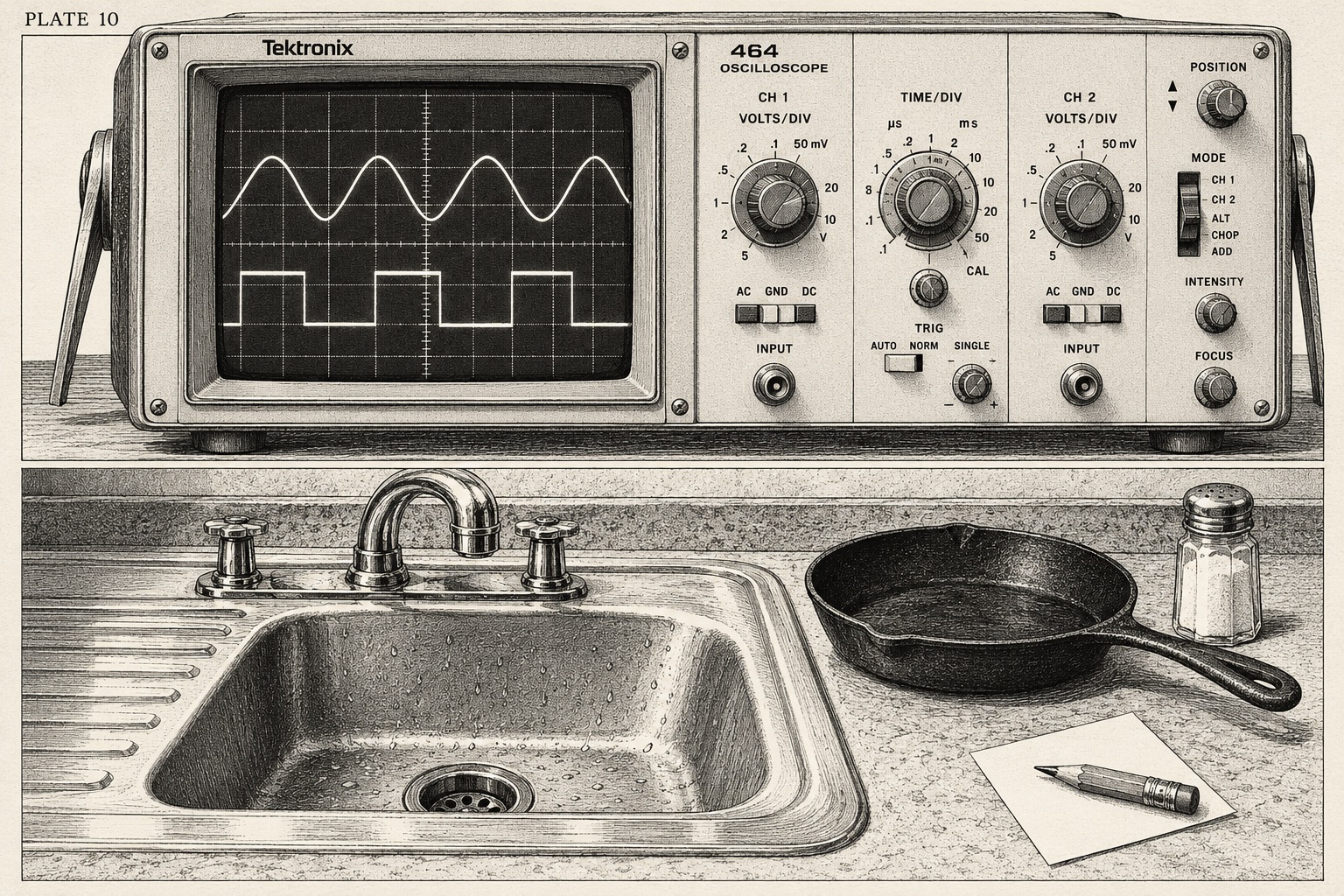
3. The Two-Inch Scrap of Paper by the Kitchen Sink: Never underestimate the humble mechanical tools required to keep a marriage of roles intact. When the chemist stood at the kitchen sink washing a frying pan while his companion spoke about her day, and a sudden insight about Monday’s factory impeller flashed into his mind, why didn't that flash destroy the domestic evening? Because he had placed a two-inch scrap of paper and a pencil stub beside the salt shaker! Five seconds to write "check impeller tip-speed" captured the poloidal chemical loop cleanly onto external cellulose, allowing ninety-nine percent of his evening attention to remain married to the woman standing beside him. That scrap of paper is the physical coupling constant that prevents work and love from colliding.
6.3 Phase III: SIMPLIFY — Ashby’s Regulator and the Humane Interface
Once we have purged our phantom obligations and married our work and our affection into a single life, we arrive at the third operational imperative: SIMPLIFY.
What does simplify mean in the cybernetic engineering of a life? In our chemist’s precise formulation: to simplify means leaving fewer decisions to the hour when one is least able to make them, and reducing the number of environmental demands that require continual, ad-hoc personal intervention.
Recall W. Ross Ashby’s An Introduction to Cybernetics (1956) and his Law of Requisite Variety. Every human nervous system—and especially a high-variety, parallel-processing nervous system prone to internal neural hyper-divergence—possesses a finite metabolic channel capacity for executive regulation on any given day. If every recurring event in your week—when to wake up, where your keys are, how to format an assay sheet, whether you promised to meet a client at two o’clock or three o’clock, when to pay the electric bill, how to transition from the laboratory mindset to the dinner table—requires a fresh, agonizing act of willpower at seven o’clock in the evening when your blood sugar is low, your regulator will inevitably fail!
When the regulator fails from decision fatigue, two things happen: either important promises drop through the floorboards, or the defensive professional mask locks onto the face like rusted iron armor.
We prevent that failure by externalizing regulatory variety onto simple, visible, low-friction structures:
1. The Single Visible Calendar and the Pre-Spoken Ledger: Do not keep three calendars (one in your head, one on office scraps, one at home). Put the week’s appointments in one visible place where your domestic partner or laboratory colleague can read them without having to interrogate you. Write down a promise before your mouth finishes making it. An appointment book does not constrict your freedom; it carries the boring regulatory variety of time-keeping on its paper back so that your living awareness remains free to think and love.
2. Standardized Falsifiable Protocols (The Two-Column Sheet): In the laboratory and the business office, do not reinvent the wheel every morning. Use explicit contracts with clearly defined scopes of work. Use the two-column template from the 1975 motel room: state the proposed mechanism in Column I, and state the exact empirical test that would disprove it in Column II. When the protocol carries the weight of verification, your personal ego never has to enter the ring.
3. The Ritual of Taking Off the Spectacles (De-Masking at the Threshold): Because an impedance-matching faceplate is designed to handle high-pressure commercial currents, it was never meant to be worn to bed. Build a simple, physical threshold ritual at the end of the workday—whether it is fifteen minutes of quiet sitting before starting the car, walking the last half-mile home from the bus stop in silence, or taking off your work spectacles and washing your hands at the kitchen sink—that signals to the nervous system: The laboratory shift is complete; the faceplate may now be set down.
Let us summarize this three-fold operational discipline in a master workbench reference table:
| Operational Imperative | Physical & Cybernetic Mechanism | Contemplative Meaning | Concrete Daily Practice |
|---|---|---|---|
| 1. PURGE | Taylor Relaxation (): Dissipating fine-scale turbulent eddies via resistive reconnection while conserving global helicity . | Holding the Universe Concise: Dropping needless self-description, spiritual vanity, and the internal defense attorney. | Monthly audit to cancel phantom obligations; crossing out COMPLETE when data is missing; plain prose in reports. |
| 2. UNIFY (MARRY) | Force-Free Alignment (): Coupling poloidal () and toroidal () vectors so and Lorentz tearing . | Co-Extensiveness of Two Truths: Answering to one undivided life across meditation cushion, lab bench, and kitchen sink. | Superinserting 15-minute storeroom stillness into workdays; keeping a 2-inch notepad by the sink so affection stays undivided. |
| 3. SIMPLIFY | Ashby’s Requisite Variety (): Attenuating routine disturbance variety via externalized buffers and impedance matching. | The Humane Interface: Recognizing the role and the observer as equally empty and functional; refusing to rely on egoic heroics. | Writing promises before speaking them; shared visible wall calendars; two-column falsification protocols; taking off the mask at home. |
6.4 Synthesis: One Life, Seven Descriptions
We are now in a position to gather all seven threads of our 1978 bookshelf—differential geometry, magnetohydrodynamics, cybernetics, Nāgārjuna’s Madhyamaka, Tantric Śrī Vidyā, Hermetic correspondence, and early process cosmology—into a single, transparent synthesis.
As we pledged in our Preface, we do not claim that these seven domains are saying the exact same thing, nor do we pretend that a differential equation proves a Buddhist sutra. Rather, each domain supplies an indispensable language for describing one undivided human life circulating among contemplation, technical craft, domestic love, and commercial exchange:
| Domain of Inquiry | What It Contributes to the Model | How It Bears Directly on Earning a Livelihood and Abiding in Presence |
|---|---|---|
| 1. Nested Toroidal Geometry () | A precise mathematical model of organized recurrence operating simultaneously across multiple scales () and two orthogonal angles (). | Commercial work (), household maintenance, and silent reflection () can be drawn as orthogonal vector components of one continuous helical trajectory () rather than rival territories. |
| 2. Magnetohydrodynamics (MHD) & Energy Balance | Dynamical constraints, cross-scale coupling (superinsertion), resistive dissipation (), and Taylor’s force-free relaxation (). | Persistence in a resistive world requires an honest material and financial budget (). A closed-looking circuit is never self-sufficient; shedding egoic turbulence () preserves core commitments (). |
| 3. Cybernetics (Ashby, Bateson, Varela, Prigogine) | Regulation through feedback loops, requisite variety, autopoietic organizational closure through open thermodynamic exchange, and extended mind circuits. | Competence never resides inside an isolated skull; it extends across tools, technicians, clients, appointment books, and partners that carry part of the regulatory work. |
| 4. Nāgārjuna’s Madhyamaka (Mūlamadhyamakakārikā) | The inseparability of conventional functioning (saṃvṛti-satya) and ultimate emptiness (paramārtha-satya / absence of svabhāva) in dependent arising. | The consultant’s role and his invoice remain fully effective and ethically binding without becoming his final metaphysical identity; emptiness enables commercial action rather than canceling obligations. |
| 5. Tantric Śrī Vidyā (Śrīcakra & Saundarya Laharī) | Devotional and geometric integration of quiescent awareness (Śiva / bindu) and dynamic expressive power (Śakti / interlocking triangles). | Ordinary manual and intellectual labor (Verse 27) becomes a direct site of contemplative practice and celebratory play (līlā) rather than a profane interruption of stillness. |
| 6. Hermetic Correspondence (Corpus, Tablet, Kybalion) | A symbolic grammar of cross-scale relation, polarity, rhythm, and the necessary alchemical cycle of ascent and descent. | Visionary insight must descend from the subtle sky back into testable earthly service; structural resemblance across household, workshop, and mind invites watchful care. |
| 7. Speculative Process Cosmology (Young, Bentov, Bohm, Capra) | The 1970s imaginative horizon of implicate/explicate unfolding, evolutionary descent into constraint, and ovoid toroidal circulation. | Establishes a hospitable cosmological atmosphere in which discipline, instrumentation, and material embodiment participate in the recovery of freedom rather than obstructing it. |
Look across this seven-layered table. What does the supertoroidal model genuinely resolve, and what does it deliberately leave alone?
First, the model resolves a crippling representational problem. For generations, intelligent men and women who loved both deep contemplative silence and rigorous technical work were told by their culture—both by hardened materialists and by otherworldly ascetics—that their lives were a contradiction in terms. They lacked a working diagram capable of portraying continuity among activities that seemed to demand incompatible identities. The supertoroid provides that diagram.
Second, the model invites a concrete, falsifiable design question on any afternoon when a practitioner feels exhausted, resentful, or fragmented: Which connections in my week are actually replenishing the whole circuit ( and ), and which connections are trapping my attention in self-protective, high-resistance repetition ()?
At the same time, because this book honors scientific and philosophical candor above rhetorical seduction, we state once more what the model does not do:
It does not derive spiritual awakening deductively from Maxwell’s equations or Navier-Stokes fluid dynamics.
It does not prove experimentally that human consciousness is a literal electromagnetic plasma ring.
It does not paper over the real philosophical disagreements between Buddhist emptiness (śūnyatā) and a self-existing Hermetic One Mind.
And it never claims that knowing the geometry of a torus exempts a human being from sweeping the floor, checking his blank controls, paying his technician fairly, or apologizing to his partner when his professional mask gets stuck at dinner.
6.5 Epilogue (Autumn 1978): The Open Center of the Wheel
Thirty chapters of ancient Chinese Taoism—a cousin to Nāgārjuna’s Middle Way—remind us that thirty spokes converge upon a single hub, yet it is on the empty opening at the center that the usefulness of the cart-wheel depends. Clay is thrown on a potter’s wheel to shape a vessel, yet it is on the hollow interior space that the usefulness of the pitcher depends. Doors and windows are chiseled into four walls to make a laboratory or a house, yet it is on the open space within the walls that the usefulness of the room depends.
Look one last time at the three-dimensional geometry of our ring torus :
Why did we insist in Chapter 2 on the strict geometric inequality ? Because if the minor radius swells until it equals or exceeds the major radius —if the tube becomes so bloated with its own self-importance that it crowds out the central opening—the ring torus degenerates into a closed horn or spindle torus, pinching its own throat shut and choking the poloidal circulation! For the field lines to wind freely through the throat and arch smoothly back over the crown, the center of the wheel must remain open.
Yet we do not worship the hole at the center of the torus as a separate deity, nor do we try to crawl into the hole and pull the hole in after us to escape the spinning rim. The central opening and the revolving rim come into existence together. Without the circulating rim of saṃvṛti-satya—the highway bridges, the mechanic’s push-broom, the motel stationery, the enzyme columns, the gas chromatograph, the Friday invoice, the grocery bag, and the kitchen sink—there would be no wheel at all. And without the ungrasping openness of paramārtha-satya—the complete absence of an anxious, self-existing proprietor (svabhāva) inside any of those parts—the wheel would freeze solid on its axle and refuse to turn.
Let us close this treatise by stating its core thesis in three plain sentences that may be taped beside any laboratory bench, accounting ledger, or meditation cushion:
The circuit is maintained by what passes through it. So is a livelihood, and so is the person who claims the livelihood. To see this clearly does not require leaving the marketplace; it requires ceasing to ask the marketplace to manufacture an independent self.
When you stop asking your scientific breakthroughs to manufacture an immortal Genius, you become free to add Column II and let the experiment correct you.
When you stop asking your commercial invoices to prove your sovereign superiority—or to convict you of spiritual sin—you become free to bill fairly, pay your colleagues on time, and buy dinner on the way home.
When you stop asking your professional faceplate to be your eternal soul, you become free to calibrate it cleanly for the sake of your clients at two o’clock, and take it off with your spectacles at six-thirty so that you can listen to the person you love.
Monday morning is coming. The pilot spray-dryer is warming up in the bay; the immobilized enzyme columns are equilibrated at pH ; the appointment ledger lies open on the desk; the storeroom crate is quiet between the drums of maltodextrin; and the frying pan by the sink is rinsed and dry.
Nothing is missing from the formula. Watch the order of addition, keep the center open, and let the whole wheel turn.
Chapter companion
Chapter 6 brings the whole book home to the workbench and the kitchen sink. Whether we use the chapter’s title words (Purge, Unify, Simplify) or the phrase engraved on Plate XV (Purge, Marry, Simplify), the invitation is the same: clear away the false postures that drain our strength, wed our quietest awareness to our most ordinary tasks, and leave the tools and the room ready for the next pair of hands.
Core teachings
- To purge is to set down the defensive stories and unexamined clutter that hide reality from us.
- To unify or marry is to let contemplative stillness and everyday craft move as one circulation.
- To simplify is to shorten the path between an action and its honest feedback.
- The threshold between the laboratory oscilloscope and the cast-iron skillet at the sink is where practice proves itself.
- What we leave behind in the world is not a monument to our name, but the ongoing usefulness of what we tended.
In ordinary life
Looking at an overcrowded desk, a practitioner sets aside two projects that were only begun out of vanity, gives full attention to the one letter that genuinely matters today, and wipes down the counter before supper.
Where to test this
The word 'purge' has a harsh history when aimed at human beings or messy lives. In our tradition, we never purge people, feelings, or human vulnerability; we only clear away the pretenses and clutter that keep us from caring well.
Sources and scope
We preserve 'Purge, Unify, Simplify' as the chapter’s title and honor 'Purge, Marry, Simplify' on Plate XV as its companion phrasing.
Questions for reflection
- What one obligation on your plate is there only to protect an image of yourself?
- Where in your home or workplace do contemplative attention and physical maintenance meet most naturally?
- What small readiness can you leave tonight for tomorrow’s hands?