

The book
Chapter 1: Nāgārjuna’s Two Truths and the Cybernetics of Emptiness
Seeing an eight-hundred-dollar invoice and a blind man’s cane through dependent arising and the extended circuit of mind.
1.1 The Disease of Spatializing the Absolute
Whenever the human intellect attempts to picture reality, its habitual reflex is to draw a boundary line on a flat plane and declare that what lies inside the circle is one substance, and what lies outside is another. For two millennia, Western metaphysics—and a great deal of misunderstood Eastern popular mysticism—has suffered from this compulsion to spatialize truth. We imagine "Appearance" as a noisy, crowded bazaar on the ground floor of existence, and "Reality" as a silent, dimly lit sanctuary located either high in the platonic heavens or deep within a subterranean vault of the soul.
If you accept that architectural premise, your life as a householder, scientist, or artisan is doomed to perpetual frustration. Every time you pick up a wrench, draft a patent claim, negotiate a consulting contract, or wash a frying pan at the kitchen sink, you must logically conclude that you have walked out of the sanctuary and into the bazaar. You become a spiritual commuter, forever spending your energy in transit between where you earn your bread and where you touch the real.
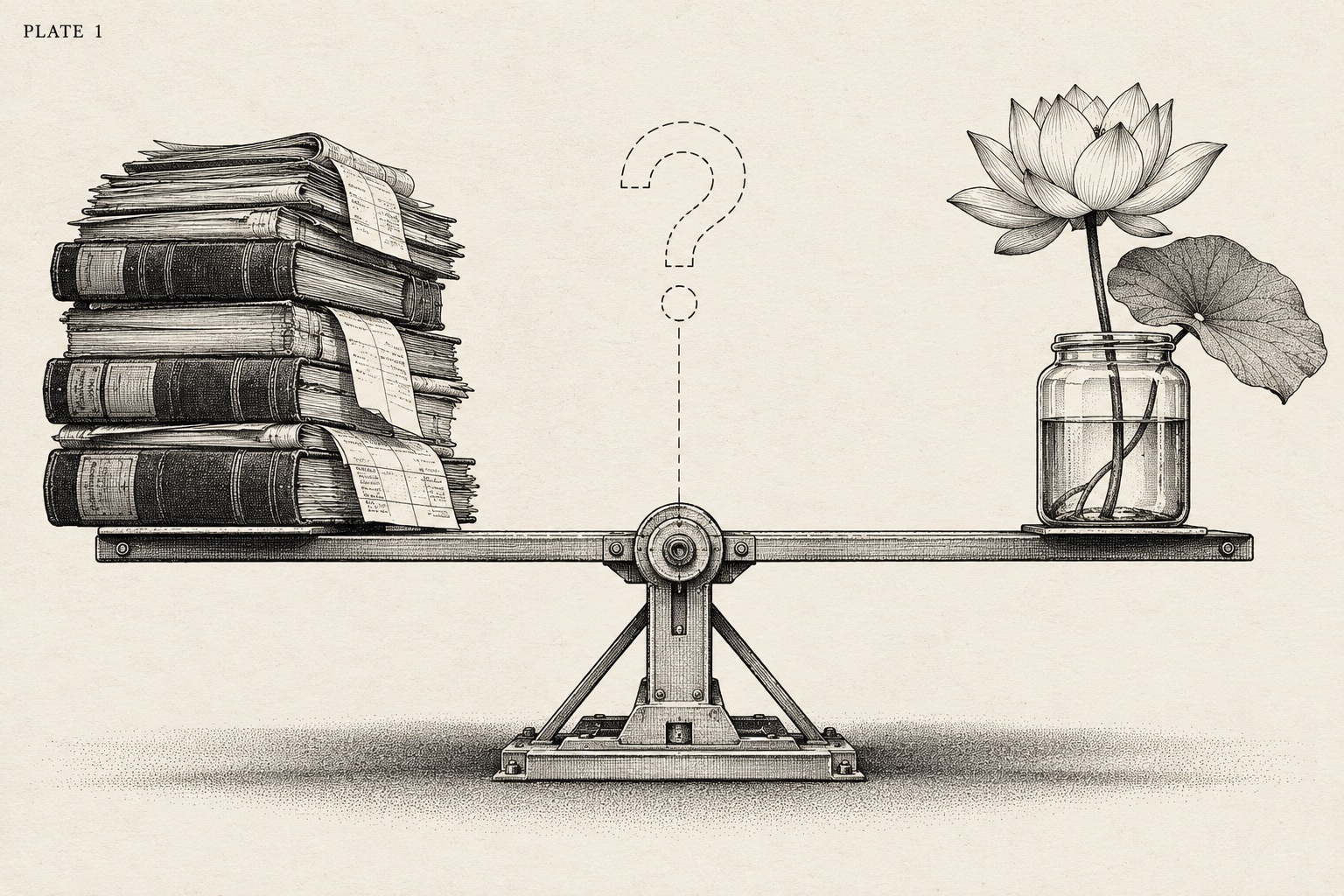
In the second century C.E., the Indian Buddhist philosopher Nāgārjuna recognized that this spatialization of the absolute is the final, most stubborn refuge of delusion. In his masterwork, the Mūlamadhyamakakārikā (Fundamental Verses on the Middle Way)—brought into clear English prose for our generation by Kenneth K. Inada in 1970—Nāgārjuna performs a surgical operation on our metaphysical habits.
In Chapter 24 (Examination of the Four Noble Truths), Nāgārjuna confronts an imaginary orthodox opponent who accuses him of nihilism. The opponent argues: If everything is empty (śūnya), then nothing truly arises or ceases; if nothing arises or ceases, then moral action, spiritual practice, livelihood, and the teachings of the Awakened One himself are all destroyed!
Listen carefully to how Nāgārjuna replies in verses 24.8 through 24.10:
The teaching of the Dharma by the Buddhas is based upon two truths: worldly conventional truth (loka-saṃvṛti-satya) and ultimate truth (paramārtha-satya).
Those who do not discern the distinction between these two truths do not discern the deep reality in the teaching of the Buddha.
Without relying upon conventional usage (vyavahāra), the ultimate cannot be taught; without understanding the ultimate, freedom (nirvāṇa) is not attained.
And then, eight verses later, in the celebrated climax of the treatise (verses 24.18–19), Nāgārjuna locks the two truths together in an indissoluble identity:
Whatever is dependently co-arisen (pratītyasamutpāda), that we declare to be emptiness (śūnyatā). That, being a dependent designation (upādāya prajñapti), is itself the Middle Way.
Something that is not dependently arisen—such a thing does not exist. Therefore, a non-empty thing does not exist.
Let us pause and examine these verses with the precision of a physicist inspecting a set of conservation laws. What is Nāgārjuna actually saying?
First, notice what paramārtha-satya (ultimate truth) is not. Emptiness (śūnyatā) is not a hidden etheric fluid, not a cosmic mind-stuff, not a metaphysical dark matter lurking behind atoms, and not a catatonic trance state in which chairs, tables, and chemical reactors vanish into a gray fog. Specifically, śūnyatā means the complete absence of svabhāva—intrinsic, self-caused, independent, autonomous existence. To say that a phenomenon is empty is simply to say that if you look for an isolated, self-enclosed core inside it that exists without reference to anything else, you come up empty-handed.
Second, notice why every phenomenon lacks svabhāva: because it arises through pratītyasamutpāda—dependent co-arising. A flame exists only in dependence upon hydrocarbon fuel, atmospheric oxygen, an ignition temperature, and convective draft. Remove the oxygen, and the flame ceases. Because the flame is 100% constituted by relationships among non-flame conditions, it possesses zero percent autonomous "flame-essence" (svabhāva).
Third—and here is the pivot upon which our entire treatise turns—Nāgārjuna points out in verse 24.14 that it is only because things are empty of fixed essence that they can function at all! Suppose, for a moment, that a chemical compound or a human self possessed svabhāva—an immutable, self-existent, independent nature. By definition, that which is self-existent and independent of external conditions cannot be altered by external conditions. A molecule with svabhāva could never enter a catalytic reaction; a bank account with svabhāva could never receive a deposit; an ignorant mind with svabhāva could never learn an equation or awaken to clarity.
Thus, conventional functioning (saṃvṛti-satya) and ultimate emptiness (paramārtha-satya) are not two rival substances fighting for territory. They are two ways of describing the exact same dynamic network. Conventional dependence makes emptiness intelligible, and emptiness excludes the frozen, intrinsic essence that would paralyze dependence. Even emptiness itself is empty (śūnyatā-śūnyatā): it is not a new absolute foundation standing behind the world, but simply the descriptive truth that the world’s processes move freely because nothing is nailed down.
1.2 Ontological Anatomy of an Invoice
To test whether a philosophical principle has teeth, we must take it out of the monastery library and drop it onto an ordinary office desk in 1978. Let us perform an ontological dissection of that most reviled artifact of conventional life: the commercial invoice.
Suppose an independent consulting chemist has spent forty hours solving a persistent emulsion instability for a regional agricultural cooperative or a food processor. On Friday afternoon, he rolls a sheet of bond paper into his IBM Selectric typewriter and types out an invoice for eight hundred dollars.
How does the dualistic seeker look at that sheet of paper? He looks at it with a mixture of guilt and secret pride. Part of him feels that by putting a dollar figure on his cognitive labor, he has prostituted the pure light of scientific inquiry to Mammon. Another part of him clutches the check when it arrives as proof that he—the sovereign, self-made expert—has conquered the struggle for survival. Both reactions stem from the same root hallucination: attributing svabhāva (independent, intrinsic nature) to the chemist, the work, and the money.
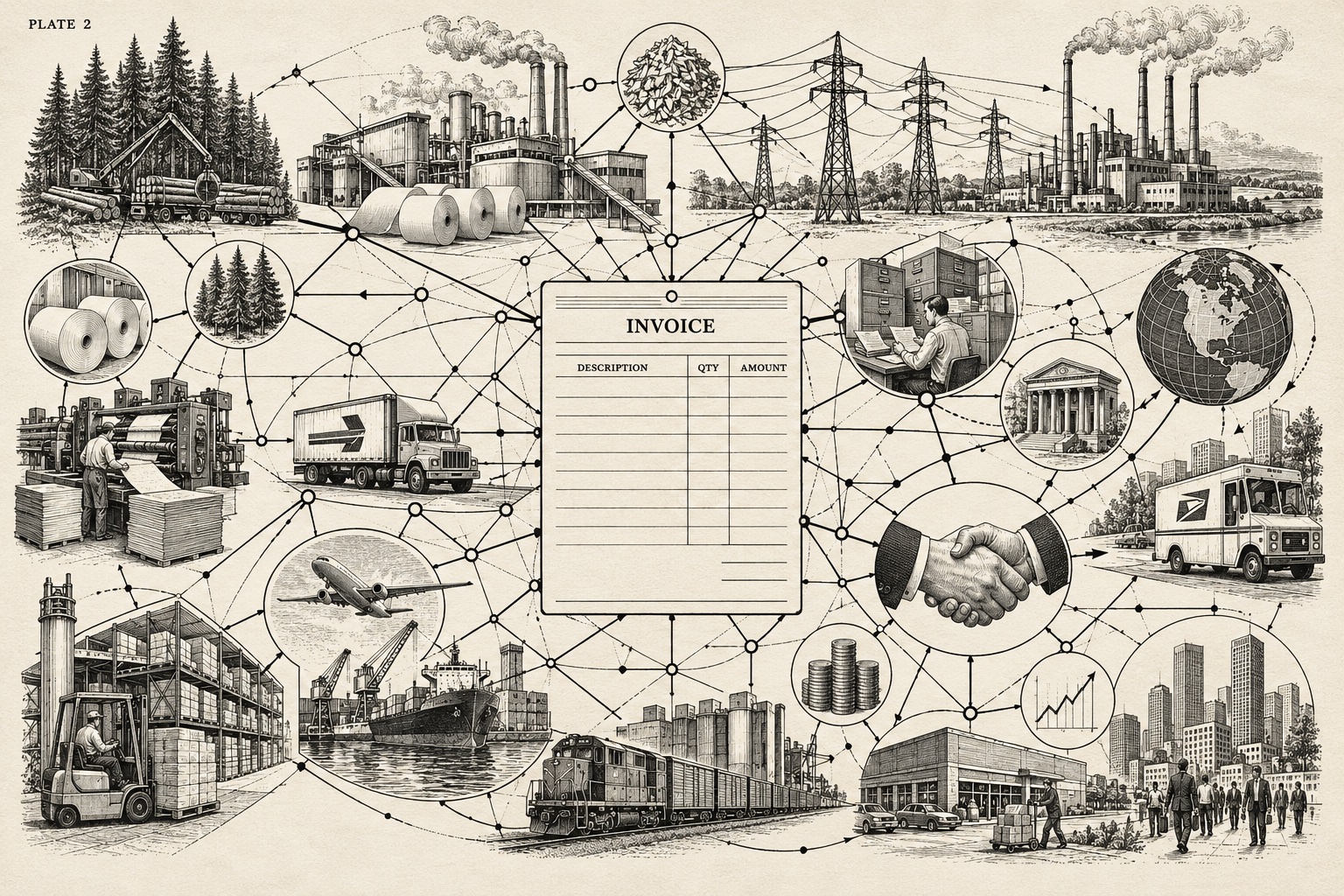
Now let us examine that same invoice through Nāgārjuna’s lens of pratītyasamutpāda. Where is the "intrinsic invoice"?
Does it reside in the cellulose fibers of the paper? Those fibers came from Douglas fir pulp harvested in Oregon, bleached in a mill on the Columbia River, and trucked south on Interstate 5.
Does it reside in the carbon-black ink ribbon? That was synthesized from petroleum feedstocks in Texas.
Does it reside in the technical solution described on the middle lines? That solution depended upon a century of colloid chemistry developed by dead European and American researchers, upon glass-blowing artisans who fashioned the viscometers, upon the technician who mixed the blank controls, and upon the client who articulated the failure mode in the first place.
Does it reside in the figure "$800.00"? That symbol has meaning only within a vast, fragile, consensual lattice of Federal Reserve clearinghouses, contract law, shared linguistic conventions, and the biological fact that human bodies require caloric replenishment that grocers exchange for currency.
Remove enough of those converging conditions, and the sheet of paper in the typewriter instantly loses its function; it becomes a mere rectangle of wood pulp. Yet—and here is the indispensable realism of the Middle Way—while those conditions hold, ignoring the invoice has real, tangible consequences. Its complete dependency does not render it imaginary, worthless, or causally inert.
The awakened scientist can therefore sign and mail an invoice without for a single instant believing that the word "Consultant" names his final, immortal essence. He can accept a client’s correction when an assay fails without experiencing that criticism as a knife-thrust against an inner metaphysical proprietor. He can recognize that his client genuinely depends upon his competence without deluding himself into thinking that he owns or controls the vast socio-ecological network in which the laboratory stands.
We may summarize this realization in a single observational maxim from our chemist’s ledger:
He entered the fee in the ledger. It depended on a hundred things, and therefore it could be entered. Had it possessed a nature entirely of its own, neither he nor the customer could have done anything with it.
Far from breeding moral laxity, seeing the emptiness of the commercial transaction deepens ethical accountability. Because no action is sealed inside an isolated private capsule, every measurement recorded, every promise spoken, and every fee charged ripples directly through the conditions affecting other lives. Dependence invites responsibility.
1.3 The Missing Middle: Cybernetics, Ashby, and Bateson
Why has it taken so long for Western thinkers to grasp Nāgārjuna’s co-extensiveness of conventional function and emptiness? Because until the mid-twentieth century, Western science lacked a rigorous mathematical language for circular causality and relational regulation. Classical Newtonian mechanics was built upon linear billiard-ball causation: Object A strikes Object B, imparting momentum , and then walks away unchanged. In a linear universe of isolated billiard balls, you are naturally seduced into believing in svabhāva—that the balls come first, and their collisions are secondary accidents.
In the post-war decades, however, a quiet revolution occurred across mathematics, neurophysiology, and control engineering: the birth of cybernetics. While a geometric torus gives us a spatial picture of recurrence, cybernetics supplies the vital intermediate language that geometry alone cannot provide: feedback, variety regulation, thermodynamic exchange, and the drawing of system boundaries.
In 1956, the British psychiatrist and systems theorist W. Ross Ashby published his foundational treatise, An Introduction to Cybernetics. Ashby asked a deceptively simple question: What does it mean for any system—whether a thermostat, a kidney, an industrial chemical reactor, or a human brain—to remain stable and effective within a fluctuating environment?
Ashby demonstrated that cybernetic study does not begin by asking what kind of "stuff" a machine is made of (iron, silicon, protoplasm, or spirit); it begins by asking what the system does—how a set of states transitions over time under the influence of coupled inputs. Central to Ashby’s work is the concept of variety (the number of distinguishable states or disturbances a system can exhibit) and his celebrated Law of Requisite Variety: Only variety can destroy (or absorb) variety. For a regulator to keep an essential outcome variable within narrow, life-supporting bounds against a stream of environmental disturbances , the regulator’s capacity to distinguish and respond must be at least proportional to the variety of the disturbances reaching it—or the channel between and must be structured to attenuate that variety before it hits the core.
Notice how Ashby’s cybernetics immediately demystifies the relationship between the contemplative and the marketplace. A human being living in 1978 is an embodied regulator embedded in a high-variety environment. Every day brings thermal fluctuations, nutritional requirements, tax codes, equipment malfunctions, and interpersonal requests. If a spiritual practitioner imagines that "transcendence" means destroying his regulatory interfaces and refusing to distinguish between a paid bill and an unpaid bill, Ashby’s law predicts the exact result: environmental variety overwhelms the unbuffered organism, and his domestic and professional life disintegrates into chaos. Conversely, if we understand simplification in Ashby’s terms, it means designing clean, externalized regulatory structures—an honest appointment book, an explicit legal contract, a reproducible laboratory protocol—that absorb and constrain routine disturbances automatically, freeing the organism’s deep attentional capacity from having to micro-manage every fluctuation.
Sixteen years after Ashby’s book, in 1972, the anthropologist and cyberneticist Gregory Bateson gathered his life’s essays into Steps to an Ecology of Mind. In that volume, Bateson takes the cybernetic feedback loop and uses it to dissolve the Cartesian boundary of the isolated ego—achieving in the language of information theory what Nāgārjuna achieved in Sanskrit verse eighteen centuries earlier.
Bateson defines a "bit" of information as a difference which makes a difference, traveling around a closed circuit of causal pathways. He then asks us to consider a blind man walking down a city sidewalk tapping a white cane:
Where does the blind man’s self begin? At the tip of the stick? At the handle of the stick? Or at some point halfway up the stick?
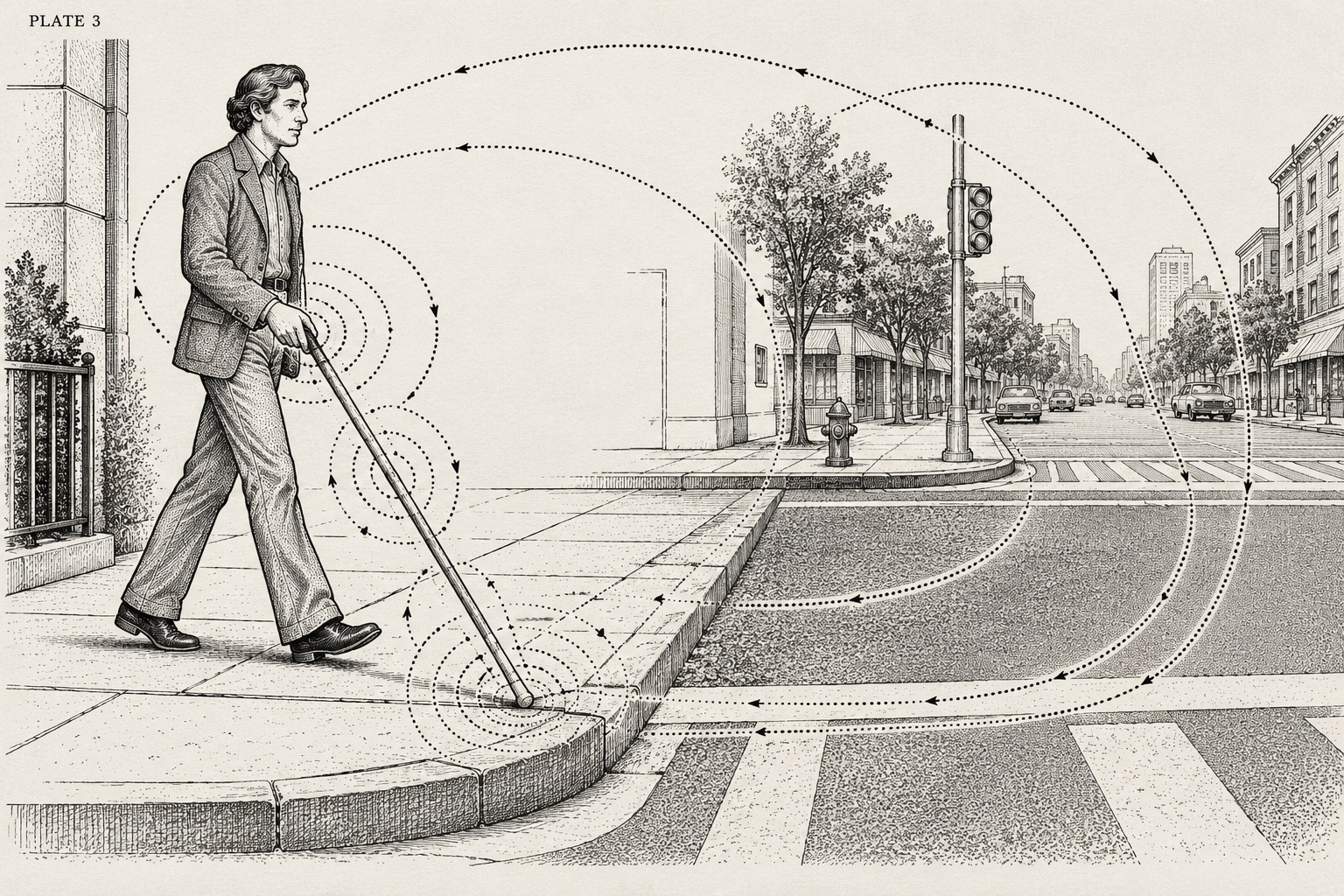
Bateson points out that these questions are nonsensical because they assume that "mind" or "self" is a localized substance locked inside the epidermis. If you want to explain the steady locomotion of the blind man down the street, the minimum unit of explanation is the entire closed cybernetic loop: street surface tip of stick shaft of stick Pacinian corpuscles in the palm sensory cortex motor cortex muscles of the arm shaft of stick street surface. Cut that circuit at any point—whether by severing the median nerve inside the arm or by sawing the wooden cane in half outside the hand—and the intelligent navigation vanishes.
Apply Bateson’s stick directly to the life of our industrial chemist. When the romantic egoist looks at a successful scientist, he points to the man’s cranium and says, "Inside that skull resides a brilliant, autonomous genius." When the cyberneticist looks at the same scientist, he sees that the "isolated genius" is a truncated, unintelligible fragment of a circuit. The functional competence of the consultant extends seamlessly across his retina, his spectacles, his gas chromatograph, his reference library, the glassware washer, the raw-material suppliers, the client’s quality-control technician, the feedback of sensory taste panels, and the household companion who reminds him to eat dinner.
The skin is a convenient osmotic membrane for keeping blood cells warm and wet; it is not the boundary of the mind or the boundary of the self.
1.4 Autopoiesis and Dissipative Structures: Closure Without Isolation
A critical objection often arises at this point in our seminars. A reader steeped in meditative interiority asks: "If I admit that my mind extends across my laboratory instruments, my clients, and my bank ledger, won't I lose my center altogether? Doesn't a living being or a contemplative consciousness require an inward closure—a quiet sanctuary that remains whole in itself?"
To answer this with scientific rigor, we must distinguish between organizational closure and thermodynamic isolation. Two major breakthroughs of the past four years illuminate this distinction.
In 1974, the Chilean neurobiologists Francisco G. Varela, Humberto R. Maturana, and R. Uribe published a landmark paper in the journal Biosystems titled "Autopoiesis: The Organization of Living Systems, Its Characterization and a Model". They asked what distinguishes a living cell from a non-living crystal or a man-made factory. Their answer was autopoiesis (self-production): an autopoietic machine is a network of processes of production (transformation and destruction) of components that, through their continuous interactions and transformations, continuously regenerate and realize the very network of processes that produced them, while constituting the system as a concrete unity in the space in which the components exist.
In other words, a living system possesses circular organizational closure: its internal catalytic and structural loops curve back upon themselves to maintain the identity of the whole. Yet—and here we must read Varela and Maturana alongside the physical chemistry of Ilya Prigogine—organizational closure is the exact opposite of material or energetic isolation!
Last December (1977), Ilya Prigogine delivered his Nobel Lecture in Stockholm, titled "Time, Structure and Fluctuations". Prigogine demonstrated that in classical thermodynamics near equilibrium, closed systems inevitably slide toward maximum entropy—disorder, uniformity, and dead inertia. However, when a system is held far from thermodynamic equilibrium by a continuous flux of matter and energy passing through its boundaries, fluctuations can be amplified through nonlinear feedback into coherent, self-organizing dissipative structures. A Bénard convection cell in a heated fluid pan, an oscillating Belousov-Zhabotinsky chemical reaction, or a living metabolic network maintains its exquisite internal geometry only because it continuously takes in high-grade nourishment, transforms it through internal cyclic loops, and dissipates entropy into the surrounding medium.
Seal a Bénard cell or a living cell off from its "mundane" exchange with the environment in order to preserve its "pure inwardness," and the inwardness dies within minutes.
While we must be careful not to claim that a corporation or a psychological habit is literally an autopoietic cell in Varela’s strict biochemical sense, the structural lesson for a contemplative life is unmistakable. Eating, earning a livelihood, calibrating instruments, paying the rent, resting the nervous system, and repairing broken tools are not shameful concessions to a fallen world. They are the exact thermodynamic boundary conditions required to sustain an embodied, wakeful life far from equilibrium. Their necessity is not a failure of transcendence; it is the medium through which presence remains incarnate.
1.5 The Circuit of Service and the Visual Instruction
Let us bring Nāgārjuna, Ashby, Bateson, Varela, and Prigogine together into a concrete operational map of a practitioner’s week. When a scientist, artisan, or consultant moves through the marketplace without dualistic division, his activity forms a closed-loop cybernetic circuit of service. Each phase of the loop generates specific feedback that regulates the next, and each phase relies upon concrete grounding conditions to keep the practitioner honest and prevent self-deception:
| Phase of the Working Circuit | What Returns as Cybernetic Feedback | Grounding Condition (What Keeps It Honest) |
|---|---|---|
| 1. Attend to a Client’s Problem | A clearer technical question and testable boundary constraints. | Listening cleanly to the client’s actual difficulty rather than projecting a mystical revelation. |
| 2. Design and Test a Formulation | Empirical measurements, assay rates, and blind sensory findings. | Experimental controls, reproducibility, mass-balance, and the willingness to be proven wrong. |
| 3. Deliver Useful Work | Agreed monetary payment, peer criticism, and future requests for service. | Clearly defined contractual scope and verifiable evidence of actual practical usefulness. |
| 4. Maintain Body and Household | Renewed metabolic capacity for attention, stillness, and relationship. | Wholesome food, adequate sleep, shared domestic chores, and unhurried affection. |
| 5. Reflect, Sit, and Simplify | Revised commitments, lower internal friction, and fewer needless conflicts. | Observable changes in daily conduct and reliability rather than exalted spiritual self-description. |
Examine this five-stage loop closely. Notice that this entire circuit can operate with luminous coherence without requiring a pompous central narrator inside the skull claiming to be the sole author of every result. Notice also that the circuit remains refreshingly human and vulnerable: noisy feedback, physical exhaustion, a spoiled reagent, or a domestic misunderstanding can temporarily perturb it. An honest non-dual philosophy does not pretend that awakening grants immunity to bruised heels or laboratory errors; rather, it shows how the circuit detects and corrects those perturbations without turning them into an existential crisis.
This brings us to the single most important visual instruction in this book.
When we turn in the next chapter to the mathematics of the supertoroid—drawing nested toroidal flux surfaces where an outer revolution () and an inner cross-sectional circulation () operate concurrently—there is a grave danger that the reader’s habitual dualism will try to hijack the diagram. The reader may be tempted to point to the outer ring of the torus and say, "That outer ring is conventional commerce (saṃvṛti-satya), where I wear my fake ego mask," and then point to a tiny core hidden inside the tube and say, "And that secret inner ring is ultimate reality (paramārtha-satya), where my true, superior spiritual self hides out from the world!"
If we draw the map that way, we have merely reproduced the old prison inside a fancier geometric cylinder. We have turned emptiness into a localized substance (svabhāva) and turned the outer working life into a second-class husk.
Instead, obey Nāgārjuna’s rigor:
1. Draw the working multi-scale toroidal circuit once—encompassing the laboratory bench, the quiet storeroom stool, the highway culvert, the invoice ledger, and the kitchen sink.
2. Label the entire dynamic architecture "Conventional Functioning (Saṃvṛti-satya)"—showing how attention, contemplative stillness (the poloidal turn ), and outward commercial and domestic service (the toroidal turn ) couple together to sustain a human life.
3. Apply the annotation "Empty of Independent Existence (Paramārtha-satya / Śūnyatā)" to the ENTIRE diagram at once—including the outer ring, the inner nested loops, the coupling equations, the person reading the diagram, and the ink on the page.
The contemplative silence inside the storeroom is just as dependently arisen as the invoice typed on Friday afternoon; and the invoice typed on Friday afternoon is just as empty of intrinsic self-nature as the deepest samādhi on a coastal cliff. Because both are equally empty, they offer zero resistance to one another. They can occupy the same space, at the same hour, in the same breath, winding together like two orthogonal vector components of a single magnetic field line across the surface of a torus.
To see how two orthogonal motions can weave an indestructible, self-stabilizing surface without colliding or canceling each other out, we must now leave pure philosophy behind and step into the differential geometry and magnetohydrodynamics of the supertoroid.
<!-- PASTE INSTALLMENTS 2 THROUGH 7 BELOW THIS LINE -->
Chapter companion
Chapter 1 brings Nāgārjuna’s teaching of the two truths into the same room as Gregory Bateson’s cybernetics. For us, emptiness is never a bleak void behind appearances; it is the fullness of relationship that allows every ordinary thing to function. By tracing the life of an eight-hundred-dollar invoice and the pathway of a blind man’s cane, the chapter shows that our minds and our obligations reach far beyond our skin.
Core teachings
- Placing ultimate truth and conventional truth on opposite ends of a seesaw makes ordinary care look like spiritual failure.
- An eight-hundred-dollar invoice has zero isolated essence, and that very interdependence is what lets it pay the rent.
- Emptiness (śūnyatā) means things arise through conditions, not that they dissolve into an amorphous substance.
- Bateson’s extended circuit shows that perception and skill move across body, tool, and street together.
- Understanding how we are woven into other lives calls us to deeper gratitude and stricter respect for consent.
In ordinary life
When you hold a paycheck or an electricity bill, you are holding forests, power lines, postal routes, and human trust. Recognizing that vast web does not excuse us from paying the bill; it transforms a dry transaction into an encounter with the living circuit that keeps us alive.
Where to test this
Systems language can become cold if we forget that people are not components in a machine, and emptiness language can become evasive if someone uses it to shrug off a debt. We hold both teachings accountable to ordinary faithfulness and personal consent.
Sources and scope
Nāgārjuna’s Madhyamaka philosophy and Bateson’s cybernetics arose in very different worlds. We honor each in its own lineage while letting them illuminate one another in practice.
Questions for reflection
- What hidden human labor and natural processes are gathered inside the nearest object on your desk?
- Where does an explanation of our interdependence stop and another person’s private boundary begin?
- How does seeing the two truths as one occasion change the way you approach an ordinary chore?
The world inside the invoice
An invoice depends on forests, pulp mills, postal workers, laboratory hours, and shared agreements. Because it has no isolated essence of its own, it can connect all those lives in a real exchange. Seeing that interdependence invites us to pay our bills and keep our promises with gratitude rather than resentment.