

The book
Chapter 4: Sacred Geometry, Śrī Yantra, and the Catalytic Loop
How a late-night reactor diagram in an El Paso motel room gave birth to the Second Column and the discipline of self-correction.
4.1 The Descent from the Bindu: How Stillness Enters the Reaction Vessel
When the young chemist stepped off the eastbound train back in California at the close of 1972, he carried in his rucksack a bruised pair of boots and an unshakeable conviction that the boundary of his organism did not stop at his epidermis. Sweeping the West Texas garage floor in exchange for half a loaf of bread had resolved the elementary moral question of livelihood: to participate in physical exchange is not a betrayal of the unconditioned, provided neither party pretends to be an isolated, self-existing monarch.
Yet an elementary moral reconciliation is not yet a complete theory of creative work. Sweeping fuller’s earth across a concrete bay is a linear, first-order mechanical task. What happens when the work required of a human being is not merely maintaining an existing floor, but conceiving and engineering a complex, previously unseen molecular architecture? How does an insight born in the silent, ungrasping expanse of contemplative awareness descend into the dense, picky constraints of stoichiometric equations, enzyme kinetics, activation energies, and laboratory glassware without losing either its stillness or its scientific rigor?
To map this movement—where concentrated awareness differentiates into structured kinetic activity and returns through empirical testing to its source—we find a remarkable geometric conversation waiting for us on our 1978 bookshelf. That conversation occurs across three distinct contemplative and symbolic languages: the Tantric iconography of Śrī Vidyā (specifically the Śrīcakra and the Saundarya Laharī), the yogic anatomy of the heart center (Anāhata cakra), and the Hermetic tradition of correspondence and rhythmic return.
Before we follow our chemist into a highway motel room at the edge of the western desert in the autumn of 1975, let us examine these traditional diagrams with the same scrupulous honesty we applied to the magnetohydrodynamic torus in Chapter 2. A true synthesis does not blur ancient contemplative symbols into modern physics equations or announce that every ancient priest was secretly designing a fusion tokamak. Rather, it allows each tradition to retain its own distinct identity while hosting a shared practical inquiry: How does ordinary human action change when isolated selfhood loses its authority, and how does silent presence couple to technical creation?
4.2 The Śrīcakra and the Saundarya Laharī: Potential and Kinetic in Devotional Play
In the Hindu Tantric tradition of Śrī Vidyā—made accessible to twentieth-century English readers through works such as the 1948 S. Subrahmanya Sastri and T. R. Srinivasa Ayyangar edition of the Saundarya Laharī and Arthur Avalon’s (Sir John Woodroffe’s) 1919 classic The Serpent Power—the dynamic unfolding of the cosmos is contemplated through a geometric diagram of extraordinary intricacy: the Śrīcakra (popularly known in the West as the Śrī Yantra).
Let us look strictly at the geometry of the Śrīcakra before we overlay a single systems-theoretic interpretation. At the exact geometric center of the diagram sits a single, dimensionless point: the bindu. Surrounding and interpenetrating this central point is a tight, symmetrical lattice formed by nine primary interlocking triangles (navayoni):
Four upward-pointing isosceles triangles, traditionally associated with Śiva (Śrīkaṇṭha)—representing quiescent, unmoving, witnessing awareness.
Five downward-pointing isosceles triangles, traditionally associated with Śakti (Śivayuvatī)—representing dynamic, differentiating, expressive power.
As these nine primary triangles intersect one another across the plane, their crossing lines automatically generate forty-three subsidiary triangles arranged in concentric rings of eight, ten, ten, and fourteen triangles around the innermost central triangle, which are in turn enclosed by concentric circles of eight-petaled and sixteen-petaled lotuses and bounded on the outside by a square sanctuary (bhūpura) with four cardinal gates.
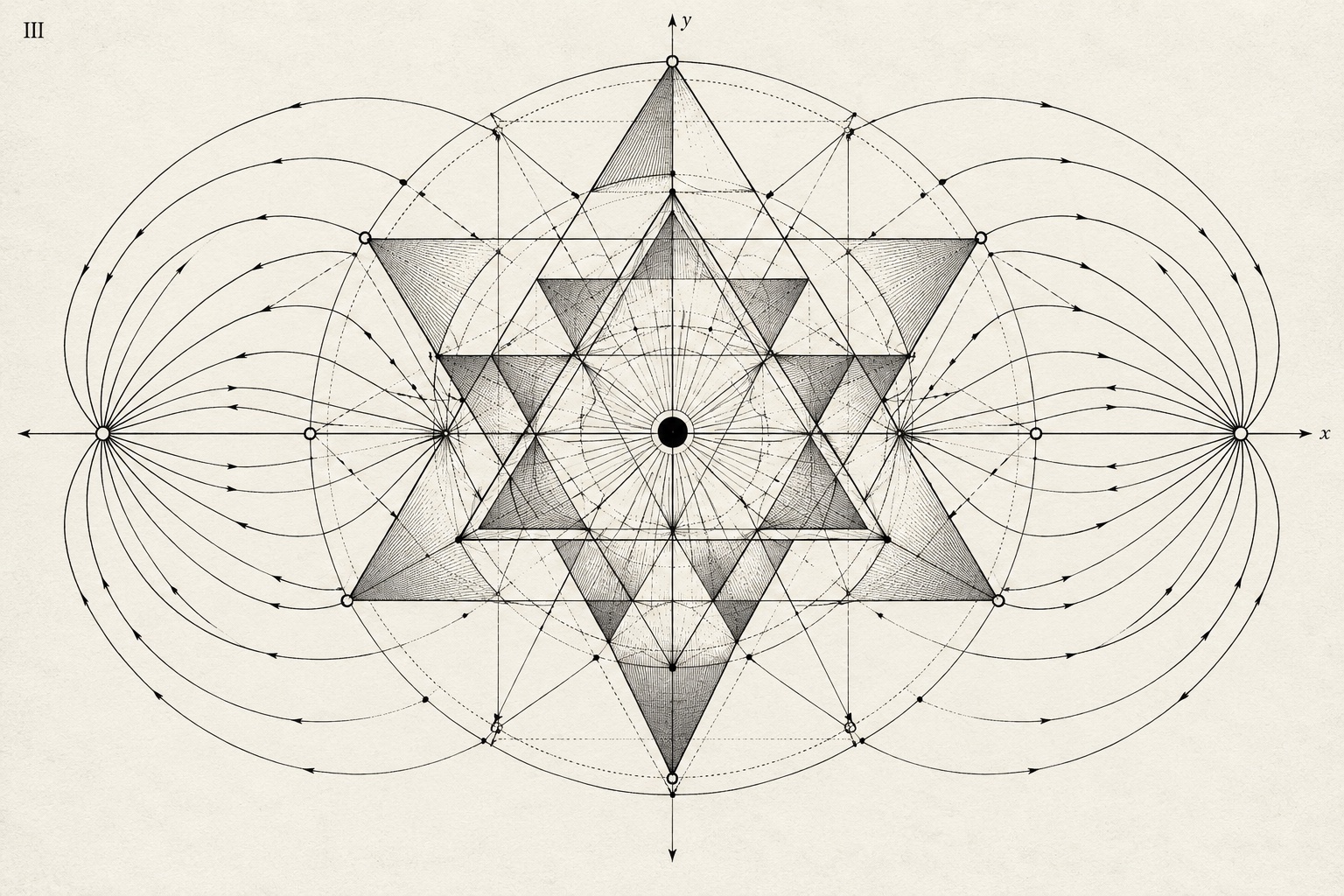
Now, as disciplined physicists and geometers, let us state clearly what the Śrīcakra is not. Mathematically, a flat plane of nine intersecting triangles—or even its three-dimensional stepped pyramidal projection known as the Meru configuration—is not a smooth manifold of topology . It is a discrete piecewise-linear projective intersection, not a parameterized ring torus, and its three-dimensional Meru form should never be carelessly redescribed as a magnetohydrodynamic plasma reactor. Nor is the central bindu a gravitational Schwarzschild singularity or a magnetic point-source driving an electromagnetic field measured in Teslas.
Why, then, does the Śrīcakra belong beside the supertoroid in a treatise on non-dual field mechanics? Because when we read the geometry alongside its foundational liturgical text, the Saundarya Laharī (The Ocean of Beauty, traditionally attributed to Śaṅkara), we discover an exact phenomenological diagram of how quiescent awareness and expressive technical activity belong inseparably together.
The opening verse (Verse 1) of the Saundarya Laharī states the fundamental coupling condition of the universe: Śiva, only when united with Śakti, possesses the capacity for activity and creation; otherwise, the Lord is unable even to stir.
In the contemplative poetry of our coastal seminars, one sometimes hears Śiva glossed as "potential energy" () and Śakti glossed as "kinetic energy" (). Provided we remember that we are speaking in poetic correspondence and not measuring devotion in joules, the insight is piercing. Pure, unmoving witness-consciousness detached from dynamic expression is inert; pure frantic activity detached from quiet witnessing awareness is blind turbulence. In the Śrīcakra, you cannot generate a single one of the forty-three subsidiary triangles of manifest structure using only the upward-pointing triangles of Śiva or only the downward-pointing triangles of Śakti. Structure arises exclusively at the intersections where quiescent presence and dynamic movement cross one another.
Trace the movement of attention across the diagram from the inside out and from the outside in (sṛṣṭi-krama and saṃhāra-krama):
1. Gathering at the Bindu: In quiet sitting, the scattered, defensive multiplicity of the technician’s mind contracts from the outer square gates through the concentric rings until attention rests undivided at the central point—not as a catatonic blankness, but as concentrated, ungrasping readiness.
2. Differentiation into the Triangles: When a technical question is introduced, that quiet readiness steps outward into the interlocking lattice of distinctions—variables, rates, geometries, constraints—without losing its connection to the center.
3. Devotional Return in Ordinary Action (Verse 27): Most remarkably for our inquiry into livelihood, Verse 27 of the Saundarya Laharī explicitly dissolves the wall between sacred contemplation and mundane daily maintenance. The poet declares that for one who sees this unity, the ordinary chatter of conversation becomes the recitation of mantra, the manual gestures of work become sacred mudrās, the walking of the legs becomes temple circumambulation, the eating of food becomes the fire-sacrifice, and lying down to sleep becomes prostration before the whole.
Similarly, when we consult the classical yogic texts translated in Arthur Avalon’s The Serpent Power (specifically the Ṣaṭ-cakra-nirūpaṇa), we encounter the Anāhata cakra located in the region of the heart, depicted iconographically as a crimson lotus of twelve petals containing two interlocking triangles (a six-pointed hexagram) at its pericarp. In our modern contemplative practice, it is deeply fruitful to visualize a "heart torus"—a warm, self-renewing poloidal circulation centered in the chest where the vertical axis of insight meets the horizontal plane of human relationship and care. We introduce this heart torus explicitly as a contemplative image for stabilizing attention in the body, never pretending that the medieval Sanskrit text was charting an experimentally measured biomagnetic flux density with a magnetometer. The steady mechanical rhythm of the biological heartbeat—systole and diastole, outflow to the systemic arteries and venous return to the right atrium—is already a sufficient bodily reminder that life is sustained by cyclic recurrence.
4.3 Three Hermetic Layers and the Productive Disagreement
Beside the Sanskrit sources on our 1978 shelf sits the Western Hermetic corpus—a body of writing that has inspired alchemists and natural philosophers from late antiquity down to modern systems thinkers. Here again, scholarly precision strengthens contemplative clarity. Rather than lumping all Hermetic language into a single undifferentiated soup, we must distinguish three historical layers available to us:
1. The Corpus Hermeticum (specifically Treatise I, Poimandres): Dating to the early centuries C.E. in Hellenistic Egypt, this philosophical dialogue presents a sacred discourse of Divine Mind (Nous) and cosmic generation, exploring how conscious intelligence beholds and participates in the architecture of nature.
2. The Emerald Tablet (Tabula Smaragdina): The terse medieval alchemical text that gives us the classic relational correspondence between "that which is below" and "that which is above," along with the vital alchemical rhythm of ascent and descent—rising from earth to heaven and descending again to earth so as to receive the unified efficacy of things superior and things inferior. Notice that for the author of the Emerald Tablet, rising into the subtle sky of spirit is only half the operation; the alchemical work fails unless the practitioner brings that subtle insight back down into the dense, testable dirt of the earth!
3. The Kybalion (1908): Published in Chicago seventy years ago by the anonymous "Three Initiates," this twentieth-century occult treatise systematized seven popular Hermetic principles: Mentalism, Correspondence, Vibration, Polarity, Rhythm, Cause and Effect, and Gender. (While modern readers frequently quote the expanded slogan "As above, so below; as within, so without," we should recognize that phrase as a modern paraphrastic synthesis of the correspondence motif rather than a verbatim quotation found across all three historical texts.)
When we place Nāgārjuna’s Madhyamaka, the Tantric Śrī Vidyā, and the Hermetic tradition around the same laboratory table, we must resist the lazy habit of declaring that "all mystical traditions teach the exact same doctrine". They do not—and their disagreement is immensely productive!
Look at the philosophical tension between them:
If a follower of The Kybalion’s Principle of Mentalism asserts that "The All is Mind" and treats that Universal Mind as a self-existing, intrinsic metaphysical substance (svabhāva), Nāgārjuna will immediately step forward to point out that a static, self-enclosed Absolute Mind could never differentiate into a blade of grass or an invoice.
Conversely, if a dry academic reader reduces Nāgārjuna’s emptiness (śūnyatā) to a cold, joyless logical negation, the practitioner of Śrī Vidyā will point to the Saundarya Laharī and remind him that manifestation is līlā—vibrant, devotional play in which sensory form and embodied craft are celebrated rather than merely refuted. (Though we must also remember that calling the world līlā does not automatically render every careless human action wise or harmless!)
By hosting a disciplined conversation among these three traditions rather than flattening them, our supertoroidal model gains three distinct, complementary diagnostic tools for the working scientist:
| Contemplative Motif | Systems-Theoretic & Practical Reading | Scientific & Philosophical Boundary (Limit) |
|---|---|---|
| Bindu and Expansion (Śrī Vidyā) | Attention gathers to stillness; action differentiates into technical steps; reflection returns. | The bindu is a contemplative focus of attention, not a physical singularity driving an MHD field. |
| Śiva–Śakti Interpenetration | Quiescent awareness and expressive technical competence belong together in every task. | They are aspects of lived action, not two separable chemical fluids or laboratory energy variables. |
| Hermetic Correspondence & Ascent/Descent | Similar organizational patterns recur across household, workshop, and mind; insight must return to embodied testing. | Structural similarity across scales invites fruitful analogy, but does not prove identical physical mechanisms. |
| Polarity and Rhythm (Kybalion) | Opposed phases (solitude and commerce, inspiration and critique) belong to one larger regulatory cycle. | Not every empirical opposition is benignly complementary, nor is every oscillation automatically restorative. |
| Madhyamaka Emptiness (Śūnyatā) | Every catalyst, substrate, scientist, and diagram functions precisely because it lacks an isolated, fixed essence. | Emptiness is the absence of independent nature in dependent things, not a vacuum energy source. |
With this triple lens in place—Nāgārjuna’s dependent functioning, Śrī Vidyā’s union of stillness and action, and the Hermetic imperative that every ascent into vision must descend back into terrestrial testing—let us open the door of Room 14 at a desert highway motel in October 1975.
4.4 The 1975 Desert Motel Room: Anatomy of an Enzymatic Vision
In the autumn of 1975, a multi-day gathering of experimental thinkers, musicians, kinetic sculptors, and renegade scientists took place on an alkali flat in the western desert. (It had no corporate sponsors, no ticket booths, and no official name—merely a circle of trucks, canvas awnings, and campfires under a vast autumn sky where ideas were traded with the intensity of desert weather.)
Our chemist spent four days at that gathering. During the afternoons, he listened to conversations ranging from Buckminster Fuller’s tensegrity domes to Gregory Bateson’s cybernetic ecology; during the nights, sitting beside the greasewood fires or walking far out onto the cracked clay playa alone, he abided in that quiet, expansive conciseness where the compulsive self-narrator drops away.
On the final morning of the gathering, as he stood watching a camp stove boil water while someone discussed the metabolic cost of keeping bacterial cultures alive in industrial fermenters, a single, deceptively simple question crystallized at the center of his attention—like a bindu point forming in the clear sky of the mind:
Why do we assume that a living biological cell is the smallest useful unit of biochemical manufacture? Why must we pay the enormous thermodynamic overhead of keeping an entire organism alive—membranes, ribosomes, DNA replication, waste transport—when all we actually require is a selected cascade of four or five enzymatic operations?
When the gathering broke camp that afternoon, the chemist did not drive straight back to the coast. Fifty miles down the two-lane desert highway, where the sagebrush met the flickering neon sign of a single-story cinderblock motor court, he pulled his car into a gravel stall and rented a room for three days.
Let us step inside that motel room. There is a sagging double bed with a mustard-colored chenille bedspread, a Formica table bolted to the wall beneath a rattling window unit, a stack of cheap cream-colored motel stationery printed with the proprietor’s telephone number, and four ballpoint pens. Outside on the highway, logging and cattle trucks pass with the same low Doppler roar he had heard inside the concrete culverts of 1972.
What was the scientific landscape of cell-free enzyme engineering in that autumn of 1975? For years, biochemists had known how to isolate individual enzymes and immobilize them on solid polymeric or glass supports to catalyze simple single-step hydrolytic or isomerization reactions (such as converting glucose to fructose). However, the moment an organic chemist wished to use cell-free enzymes to perform true multi-step biosynthetic construction—building complex carbon-nitrogen skeletons such as indole alkaloids or specialty pharmaceuticals from simple precursors—he hit a formidable thermodynamic wall.
Synthetic bond-forming steps almost invariably require stoichiometric inputs of expensive biological cofactors: adenosine triphosphate () to drive phosphorylation and activation, or nicotinamide adenine dinucleotide phosphate ( / ) to drive selective reductions, or -adenosylmethionine () for methylations. In a living yeast or plant cell, the whole cellular metabolism continuously regenerates those cofactors. In a cell-free glass beaker, if you simply dump in stoichiometric quantities of pure crystalline or , the reaction runs once, converts your expensive cofactor into spent or , and grinds to a halt—having cost ten thousand dollars per gram of product! (Indeed, at that very moment in the mid-1970s, chemical engineers such as Robert Langer, Colin Gardner, Carter Hamilton, and George Whitesides at MIT were preparing their landmark 1976 AIChE Journal paper, "Enzymatic Regeneration of ATP. I. Alternative Routes," examining how cell-free cofactor regeneration might make cell-free synthesis economically and kinetically viable.)
Sitting at the Formica desk in Room 14, with the stillness of the desert still steady in his chest, the chemist began to cover the motel stationery with arrows.
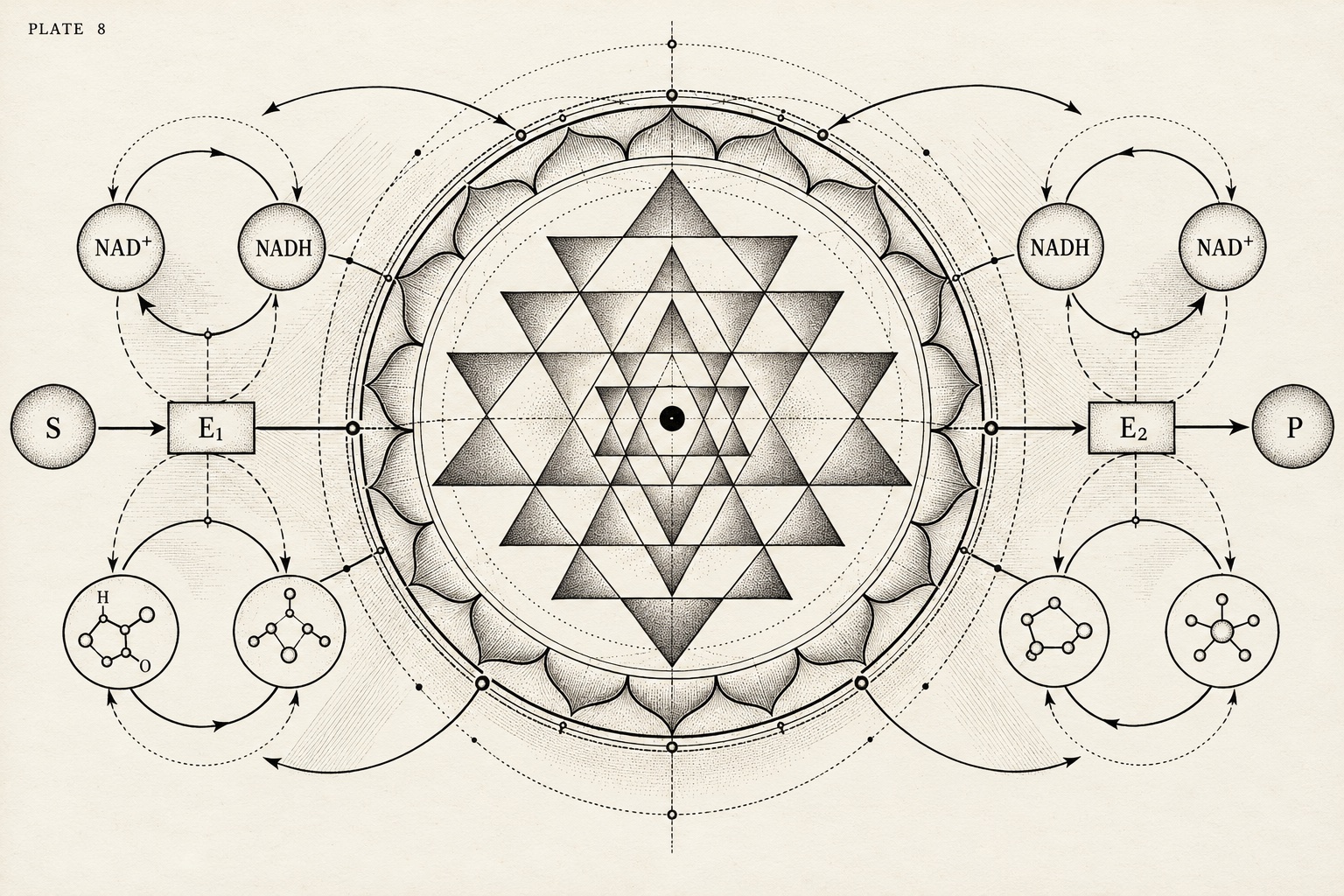
First, he drew the primary synthetic spine—the outer toroidal trajectory . A simple, inexpensive aromatic precursor molecule enters the reactor vessel and encounters Enzyme , converting it to Intermediate ; Intermediate passes immediately to Enzyme to form Intermediate , proceeding through a four-step cascade to yield a complex target alkaloid product . (Notice a crucial chemical distinction that sloppy retellings often muddle: the enzymes are the biological catalysts, while the synthesized alkaloid is the product of the cascade, not a catalyst itself unless a separate autocatalytic role were empirically demonstrated!)
Next, he looked at Step 2 and Step 3 of his sequence, where an essential cofactor was consumed and discharged as spent cofactor . If accumulated, the reaction died by mass-action inhibition and cofactor starvation.
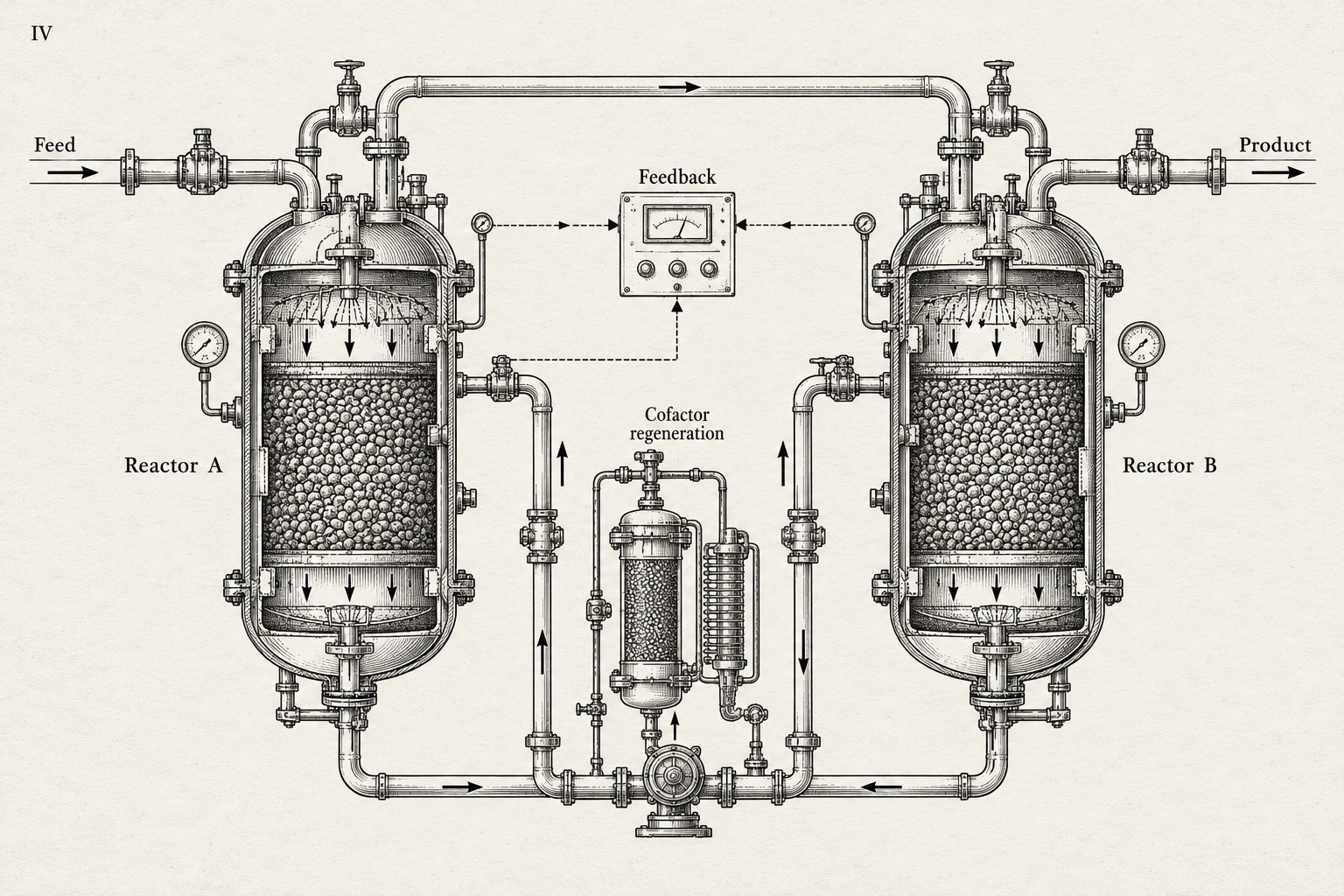
Beside the main sequence, in the margin of the motel stationery, his pen drew a compact, returning circular pathway : an auxiliary enzymatic sub-cycle utilizing a cheap, sacrificial secondary substrate (such as acetyl phosphate or formate) and an immobilized regenerating enzyme that seized the spent cofactor the instant it left the main channel, restored its chemical potential energy, and reinjected it as directly into the teeth of Enzyme .
Look at the differential kinetics he was sketching on that motel pad, and compare them directly to the equations of superinsertion we derived in Chapter 2:
Here, the primary synthetic pathway is , and the auxiliary cofactor-regeneration cycle is the superinserted recurrent process coupled through the shared cofactor pool !
Across the top of the motel stationery, he printed in capital letters: CATALYTIC SUPERINSERTION. Why did that word delight him so deeply? Because one recurrent operation had entered into the direct service of another. By nesting a fast, tight regenerative loop () inside the primary synthetic flow (), the cell-free apparatus no longer needed a living organism to stay in motion; the reaction network had acquired functional closure!
4.5 The Morning After Vision: Crossing Out "COMPLETE"
Let us pay close attention to what happened between midnight of the second day and nine o’clock on the morning of the third day in that motel room, for this is the moment where genuine non-dual science parts company with psychotic grandiosity and New Age self-indulgence.
At midnight on the second night, having worked for thirty-six hours on black coffee and desert adrenaline, the chemist leaned back in his chair and stared at his master sheet of motel paper. The arrows formed a breathtakingly symmetrical nested diagram—a chemical Śrī Yantra of interlocking catalytic loops. In the intoxication of the moment, the name "superinsertion" pleased him even more than the chemistry. He felt that he had plucked a finished secret straight out of the implicate order. With a flourish of his ballpoint pen, he drew a broad, dark circle around the entire reaction scheme and wrote a single word at the bottom:
COMPLETE.
He went to sleep feeling like an alchemical sovereign who had just rendered half the pharmaceutical laboratories in the world obsolete.
Six hours later, the desert sun came blazing through the gaps in the motel venetian blinds. The air-conditioner compressor kicked on with a metallic shudder. The chemist got out of bed, washed his face in the chipped porcelain sink, poured a glass of lukewarm tap water, and sat back down at the Formica table to look at his masterpiece.
For five full minutes, he sat in complete silence—not the intoxicating, visionary trance of midnight, but the sober, transparent stillness of paramārtha-satya, which has no emotional investment in defending yesterday’s cleverness. And in that clear morning light, he picked up his pen and drew two heavy black lines straight through the word COMPLETE.
Why did he cross it out? Because when he looked at the diagram without the defensive filter of the "inspired inventor," he saw the glaring physical holes between his arrows:
1. Unverified Kinetics: Several of his neat ballpoint arrows represented enzymatic transformations for which no in vitro turnover number () or Michaelis constant () had ever been measured outside a living plant vacuole. An arrow on paper has zero activation energy; a bond cleavage in water at has a strict Gibbs free energy barrier .
2. Incompatible Boundary Conditions: In his midnight enthusiasm, he had placed Enzyme and the regenerating enzyme inside the same homogeneous aqueous phase. Yet looking at the known biochemistry, required a mildly acidic pH () and sulfhydryl protection, whereas the proposed regeneration enzyme operated optimally at pH in the presence of divalent magnesium ions () that would severely inhibit !
3. Topology vs. Geometry: He recognized that a catalytic cycle on a reaction chart is a graph in concentration space, not automatically a stable spatial torus in three-dimensional fluid flow. Unless the enzymes were spatially compartmentalized—for instance, immobilized on sequential porous beds or separated by hollow-fiber ultrafiltration membranes—intermediate diffusion and product inhibition would choke the loop before it completed three turns.
In short, his small returning cofactor path was an admirable structural intention, not yet a functioning chemical cycle.
Now watch what the chemist did next. A fragile ego, discovering at nine in the morning that its midnight revelation is full of holes, reacts in one of two dualistic ways: either it hides the flaws and bullies ahead into grandiose pseudo-science, or it collapses into shame, tears up the pages, and concludes that the vision was worthless trash.
Because our chemist had learned in the culverts of 1972 that he was not an isolated proprietor defending an infallible self, he did neither. He saw that the midnight vision (the descent from the bindu) had done its exact job: it had generated a rich, novel topological hypothesis. Now it was time for the second half of the Hermetic and cybernetic circuit—coupling that hypothesis to rigorous empirical falsification.
4.6 The Two-Column Ledger: Building a Machine That Can Correct You
On the evening of the third day, the motel proprietor—a practical woman in her sixties who had watched the quiet young man through the office window as he filled page after page without turning on the television—knocked on the door of Room 14 to bring clean towels and a fresh pad of motel stationery.
She glanced at the stack of inked diagrams on the Formica table. "Have you made it?" she asked kindly.
The chemist looked down at his papers, smiled, and gave an answer that belongs over the doorway of every scientific laboratory and every contemplative hall in the world:
"I have made something that can now be asked a question."
What had he spent the third day constructing on that fresh pad of paper? He had drafted a clear description of the proposed multi-stage cell-free reactor and its potential industrial applications. But on the very first sheet of the packet, he had ruled a vertical line down the middle of the page to create a second column:
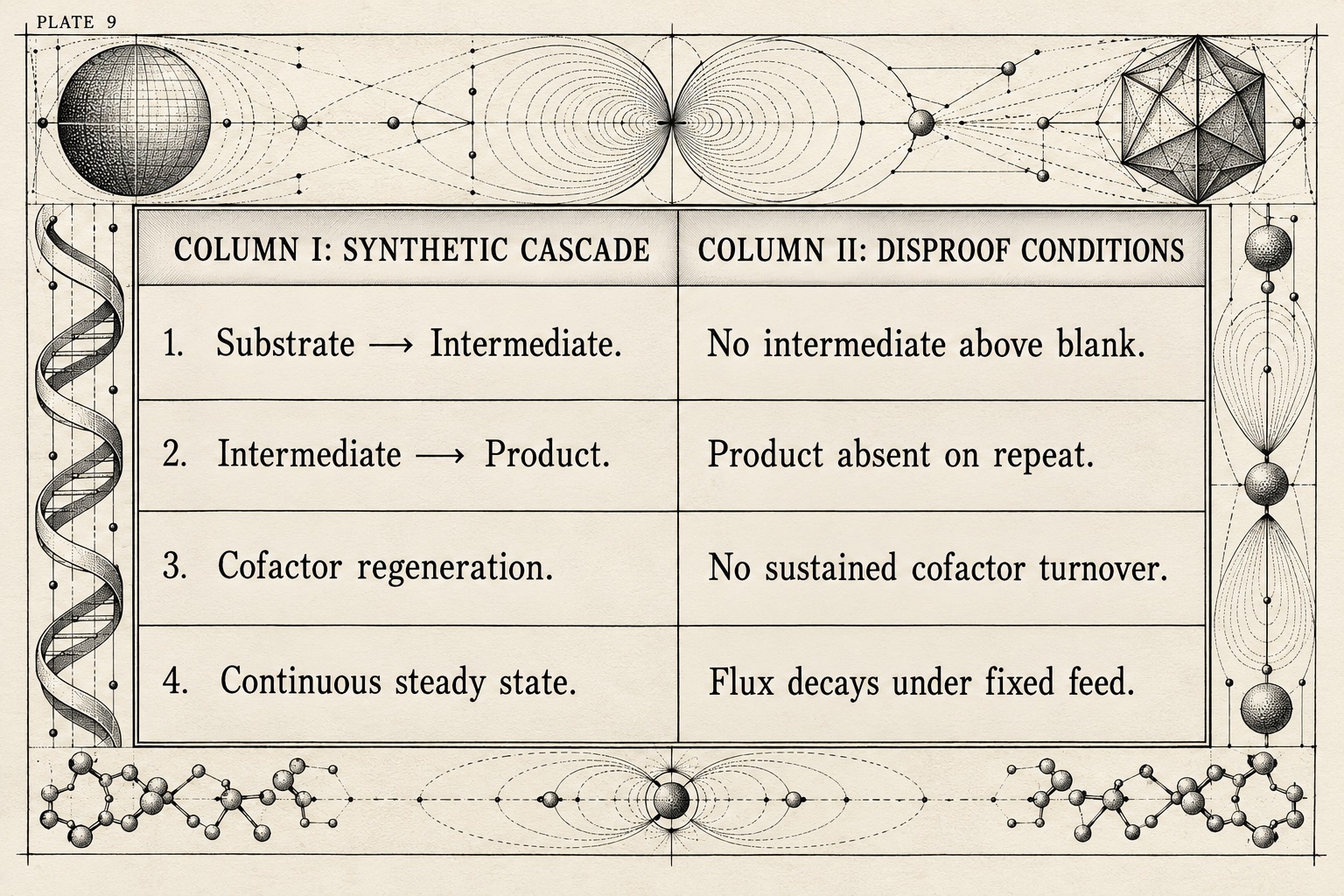
| Column I: Proposed Catalytic Step & Loop Architecture | Column II: Empirical Falsification Protocol (What Would Disprove Each Step) |
|---|---|
| Step 1: Immobilization of primary synthase and on cyanogen-bromide-activated agarose beads in Column A. | Disproof Condition 1: If specific activity drops below of soluble native enzyme upon covalent coupling, or if half-life at , reject single-phase immobilization. |
| Step 2: Superinsertion of the cofactor regeneration loop ( + sacrificial phosphate donor) via hollow-fiber recycle stream. | Disproof Condition 2: Measure total turnover number (). If due to cofactor hydrolysis or membrane fouling, the loop is economically non-viable. |
| Step 3: Buffer and pH zoning across compartmentalized beds (pH recycle adjustment). | Disproof Condition 3: Run matched blank controls without . If salt accumulation from pH adjustment inhibits within five residence times, the uncoupled compartments cannot close the cycle. |
Look at those two columns side by side. The vision had not diminished by one millimeter when he added the second column; rather, the vision had acquired doors through which other human beings—technicians, critics, experimental controls, and nature itself—could enter and participate!
When he packed his bag on the fourth morning and carried his suitcase out to the gravel parking lot, the metal wastebasket beside the motel desk contained far more crumpled pages than the manila envelope under his arm. Driving west toward the mountains, he reflected on the transformation that had occurred over those seventy-two hours:
Before 1975, he had secretly assumed that "spiritual inspiration" in science meant receiving a finished, untouchable blueprint from on high—a revelation whose brilliance proved the special status of the receiver. Now he understood that true non-dual inspiration is the willingness to step out of self-protective vagueness and build an explicit, testable apparatus that is capable of correcting its builder.
4.7 Cybernetic Synthesis: Why the Falsifiable Loop Is the Ultimate Non-Dual Act
Let us step back and connect the 1975 Motel Room Breakthrough directly to the overarching thesis of our treatise. Why is the addition of that second column—what would disprove each step—such a decisive milestone in the geometry of being?
In the popular counterculture of the 1970s, there is a widespread suspicion of the scientific method’s demand for controls, falsifiability, and blind testing. Many earnest spiritual seekers view empirical rigor as "cold, left-brain cynicism" that murders the delicate flower of mystical intuition. They prefer to keep their visions wrapped in unfalsifiable poetic fog so that their inspiration can never be proven wrong.
Examine that preference through Nāgārjuna’s Madhyamaka and Bateson’s cybernetics, and you will see instantly that unfalsifiable mysticism is the ultimate refuge of the ego (svabhāva)! Why does a person refuse to specify what would disprove his idea? Because he has identified his immortal selfhood with the idea! To him, an experimental failure is not a helpful bit of cybernetic information (a difference which makes a difference); it is a humiliating personal execution. To protect his fragile inner proprietor from being corrected by reality, he cuts the feedback wire from the environment () and sits inside an open-loop hallucination where he is always right.
Now look at the practitioner who truly abides in śūnyatā—holding the universe concise. Because he knows that neither he nor his midnight diagram possesses independent, intrinsic nature (svabhāva), he has zero metaphysical pride at stake in whether Enzyme prefers pH or pH !
When an assay fails at the laboratory bench on Tuesday afternoon, the non-dual scientist does not experience an existential crisis; he experiences delight, because the universe has just answered his question clearly! By writing Column II alongside Column I in the motel room, the chemist took a private internal loop (, the midnight vision arising from the bindu) and opened its coupling channel () to the shared, verifiable world of saṃvṛti-satya (, the laboratory bench, the technician’s assays, and the physical laws of mass action).
Notice the complete topological parallel between the three levels of our study in this chapter:
1. At the Biochemical Level: A linear synthetic cascade rapidly starves unless a regenerating cofactor loop is superinserted beside it, turning spent back into active so the work can continue.
2. At the Tantric & Hermetic Level: Quiescent awareness (Śiva / the bindu / the ascent to heaven) remains barren unless it interpenetrates dynamic, differentiated manifestation (Śakti / the forty-three triangles / the descent to earth).
3. At the Epistemological Level: Visionary intuition remains a sterile private daydream unless a falsifiable error-correction loop (Column II) is superinserted into the design, allowing empirical reality to regenerate and refine the scientist’s understanding.
The wastebasket full of crumpled motel stationery was not the debris of failure; it was the necessary dissipative entropy export () through which a coherent, far-from-equilibrium structure crystallized.
Yet a vision in a desert motel room, even one equipped with falsification protocols, is still a solitary performance. Eventually, the car must pull off the highway and enter the city. The chemist must walk through the glass doors of an industrial enterprise, sit down in a noisy room full of colleagues, bosses, technicians, and clients who do not care about Nāgārjuna or the Saundarya Laharī, and deliver accountable work on a Friday deadline while managing a nervous system that fires at three times the normal clock rate.
How does the supertoroid operate under fluorescent lights, corporate contracts, and domestic obligations? Let us follow the chemist into the corporate laboratory in Chapter 5.
Chapter companion
Chapter 4 brings together three unforgettable images: the interlocking triangles of the Śrīcakra, a continuous-flow enzyme reactor in a coastal laboratory, and a sheet of motel stationery west of El Paso at two in the morning. Its crowning moment is not the brilliance of the chemist’s midnight diagram, but the courage to strike out the word COMPLETE and rule Column II down the margin.
Core teachings
- In contemplative reflection, the still center (bindu) and the differentiated network of action nourish one another.
- Superinsertion means introducing a restorative return loop into a process that would otherwise exhaust itself.
- The most dangerous hour for any spiritual or scientific vision is when its creator declares it complete.
- Ruling a Second Column turns a private intoxication into an honest proposal that reality can test.
- A teaching is trustworthy only to the degree that it builds in a way for its own errors to be heard.
In ordinary life
Whenever we fall in love with a new way of living or working, we can honor that enthusiasm by writing down right beside it what concrete signs would tell us the experiment is failing or hurting someone.
Where to test this
Placing a sacred Hindu yantra beside a biochemical flow chart is a bold contemplative juxtaposition, and we must never pretend that enzyme kinetics explain Tantric liturgy or that Śrī Vidyā practitioners endorse our chemistry. We also guard the Second Column so it remains a practice of humility rather than performative self-doubt.
Sources and scope
We honor the historical and devotional integrity of Śrī Vidyā on our Lineages page, study the reactor as a biochemical model, and practice the Second Column as our core discipline of accountable inquiry.
Questions for reflection
- When have you been tempted to write COMPLETE underneath an idea before testing it against Monday morning?
- What is the difference between losing faith in a vision and giving that vision a Second Column?
- What small restorative loop keeps your daily work from running dry?
Crossing out COMPLETE
Ruling Column II transforms a midnight vision into a living commitment that reality and other people are allowed to correct. In daily life, it can be as simple as writing: I believe this weekly meeting helps our team; I will reconsider if after a month no one can name a decision it made clearer. Plate XIII preserves that pencil line.