

The book
Chapter 3: The Pilgrim in the Culvert (The 1972 Field Experiment)
Walking the desert highway, sheltering in a concrete drainage pipe, and discovering reciprocity behind a push-broom in Pecos County.
3.1 The Fallacy of the Unconditioned Escape
When a young scientist first grasps the mathematical elegance of the supertoroid and the philosophical clarity of Nāgārjuna’s śūnyatā, he almost inevitably falls prey to a charismatic operational error. He confuses the emptiness of the circuit with the repudiation of its material conduits.
Having seen on the blackboard that no phenomenon possesses svabhāva (intrinsic, self-established nature), and having recognized that the anxious, hoarding ego is a parasitic eddy burning up magnetic energy in resistive friction, his immediate impulse is to stage a radical boundary violation. He looks at his checkbook, his laboratory lease, his keys, and his calendar, and declares them to be symptoms of spiritual cowardice. He reasons to himself: If the universe is truly a self-sustaining toroidal field, and if my separate ego is an illusion, then I should be able to step out of my door without a single dollar in my pocket, sever every commercial contract, abandon all planning, and allow the macro-toroid of the cosmos to carry me like a weightless charged particle along a magnetic flux line!
It is a noble, intoxicating hypothesis. In the intellectual ferment of the early 1970s, thousands of bright young minds across North America attempted some version of this experiment. Most of them washed up six months later in rural communes or urban crash-pads, discovering that when you abolish explicit rules and budgets without abolishing human hunger, you do not get cosmic harmony; you get unacknowledged tyranny, unwashed dishes, and exhaustion.
Yet when a trained experimentalist—a chemist habituated to keeping a notebook, observing boundary conditions, and respecting empirical falsification—undertakes such a walk, something far more instructive occurs. Even when his initial hypothesis is flawed, the road itself acts as a ruthless, loving laboratory that corrects his premise.
In the spring of 1972, a twenty-six-year-old organic chemist locked the door of his California apartment, left his wallet and bankbook in a desk drawer, and stepped onto the shoulder of the highway with a canvas rucksack and a folded road map on which he had circled the words NEW ORLEANS. Between his boot-soles and the mouth of the Mississippi River lay two thousand miles of Mojave scrub, Arizona mesas, New Mexico high plains, Texas limestone, and Louisiana bayou.
He proposed to cover that entire distance on foot, without money, without pre-arranged caches of food, and without purchasing any guarantee that Wednesday would resemble Tuesday. In his pocket notebook, on the morning of his departure, he wrote a solemn protocol: An empirical field test in the generosity of the world. To determine whether the universal supertoroid provides total support when egoic control and monetary mediation are purged.
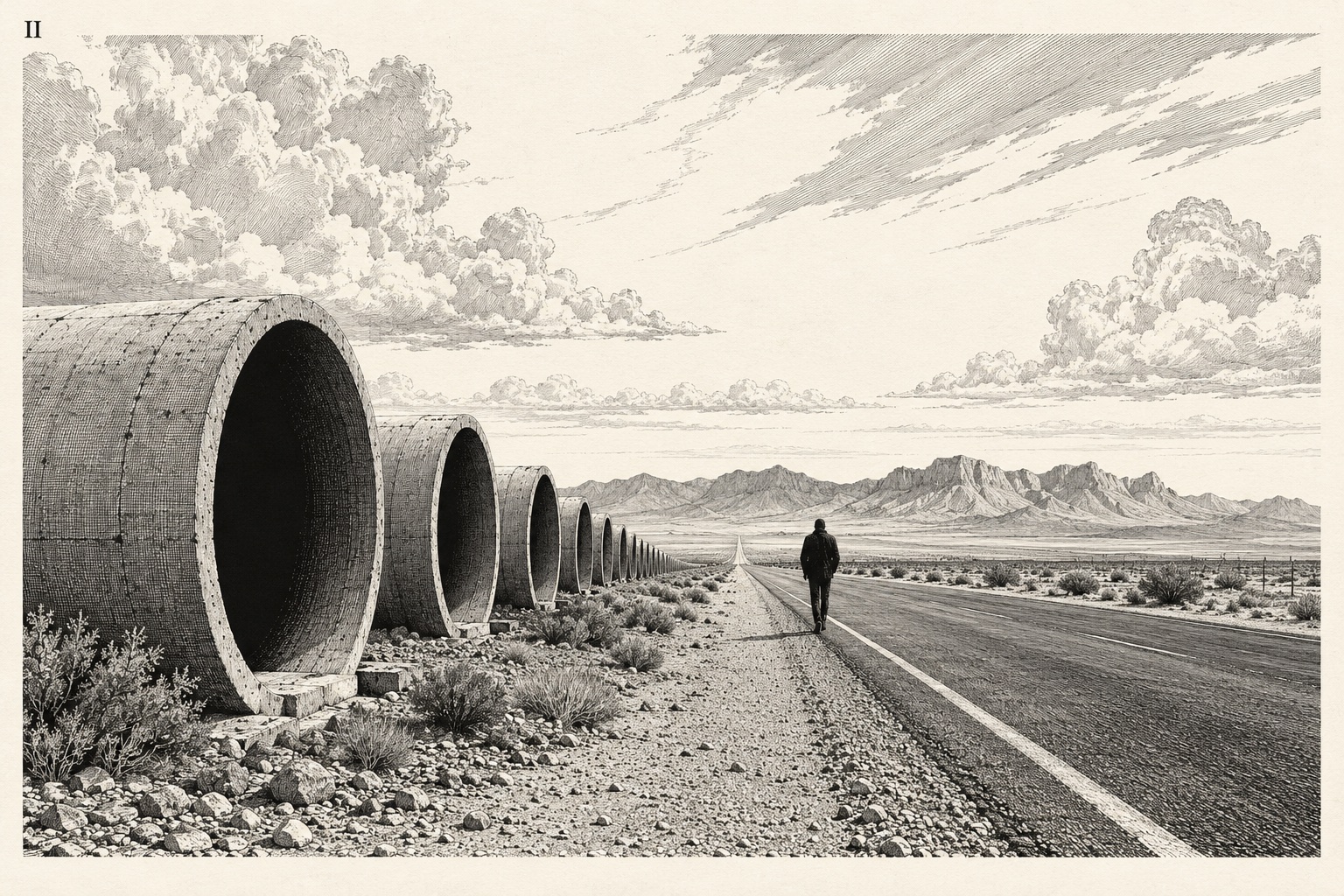
Let us walk beside him across those two thousand miles, examining both the raw entries of his field ledger and the cybernetic mechanics of what actually transpired between the Pacific coast and the Gulf of Mexico.
3.2 The Secret Demand of the First Hundred Miles
For the first hundred miles—climbing out of the coastal valleys toward the dry, wind-scoured passes leading into the Mojave Desert—the chemist walked in a state of near-euphoric pride. Every time a meadowlark sang from a fencepost, or a cool breeze arrived at the crest of a grade, he recorded it in his notebook as a positive data point confirming his theory of cosmic provision.
Notice the subtle cybernetic trap hiding inside his exhilaration: for those first hundred miles, he secretly expected the world to reward the precision of his proposal.
Examine that expectation through Nāgārjuna’s lens. The chemist believed he had renounced egoic control. In reality, he had merely traded a gross, ordinary form of control (carrying twenty-dollar bills in a leather billfold) for a subtler, far more grandiose contract. In his unspoken imagination, he had cast himself as the Heroic Renunciate, and he had cast "The Universe" as an omnipotent, doting laboratory director who was obligated to feed and shelter him in exchange for his theatrical display of faith. He had not stepped out of the marketplace at all; he had simply tried to open a line of metaphysical credit with the absolute!
By the evening of the fourth day, east of Barstow, the desert began to administer its empirical corrections. The sun dropped behind the jagged volcanic ridges in a blaze of violet and copper, and within forty minutes the ambient air temperature plummeted by thirty-five degrees. A stiff, gritty wind came howling down the alluvial fans, driving sharp quartz sand against his ankles. His water canteen was a quarter full; a blister the size of a silver dollar had risen and burst on his right heel; and there was neither a house, a tree, nor a gas station visible along the dark ribbon of the two-lane highway.
Where does a penniless pedestrian go when the desert wind drops toward freezing across a barren plain? He goes down into the embankment, underneath the roadbed, and crawls inside a concrete highway drainage culvert.
3.3 The Geometry of the Culvert: Boundary Conditions in the Concrete Tube
It has become part of the folklore of our seminars to romanticize those concrete drainage pipes as "cylindrical toruses" where the desert pilgrim achieved cosmic illumination. Let us strip away the romanticism and look at the culvert as our chemist actually experienced it at two o’clock in the morning in April 1972.
Mathematically, a precast concrete box or pipe culvert running beneath an interstate embankment is a hollow right circular cylinder of radius and length , parameterized in cylindrical coordinates by . Topologically, an open cylinder is what you obtain when you take a ring torus and sever it across two poloidal cross-sections, leaving both ends gaping open to the desert night. It is a provisional shelter, not a closed cosmic womb.
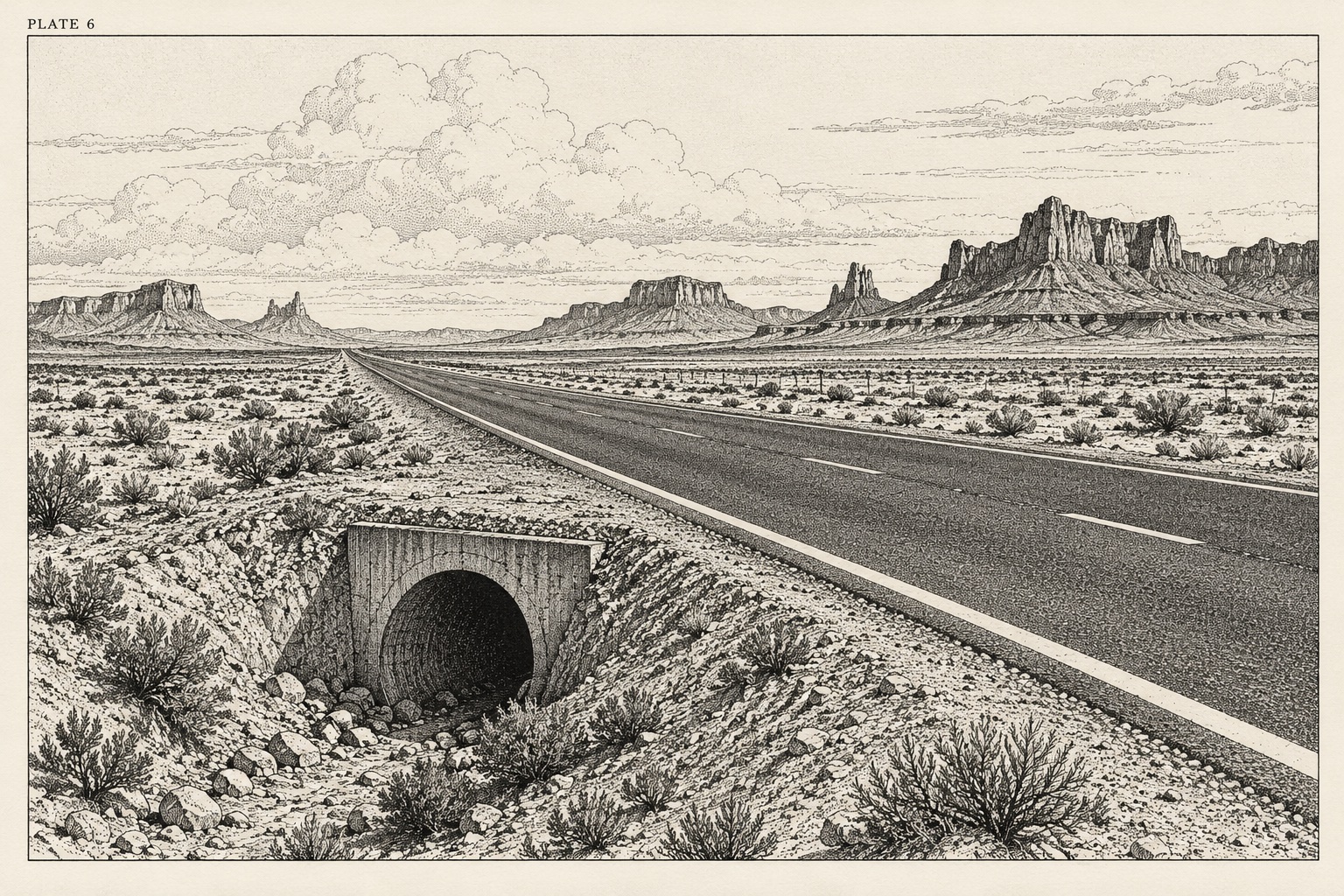
Inside a forty-eight-inch corrugated steel or poured-concrete culvert pipe, the physical boundary conditions are stark and unforgiving:
1. Thermal Conduction: Dry concrete possesses a thermal conductivity , roughly fifty times higher than still air. When the chemist unrolled his thin wool blanket directly against the curved bottom arc of the pipe (), the concrete acted as an infinite heat sink, wicking body heat steadily out of his hipbones and shoulder blades ().
2. Acoustic Resonance: Whenever an eighteen-wheel diesel freight truck roared across the asphalt directly above the embankment at seventy miles per hour, the cylindrical cavity functioned as a low-frequency Helmholtz resonator and waveguide. The curved concrete wall did not block the industrial world; it gathered the mechanical vibration of tires, axles, and combustion cylinders and returned them as a long, booming, hollow weather that vibrated directly through the pilgrim’s sternum.
3. Fluid Vulnerability: A culvert exists for one civil-engineering purpose: to channel flash-flood runoff from the high desert washes under the highway so the roadbed does not wash out. Sleeping inside a culvert requires checking the sky toward the distant mountain ranges before dark; a thunderstorm twenty miles away can turn a dry concrete tube into a lethal hydraulic nozzle before midnight.
Lying curled on the cold concrete arc at three in the morning, rubbing his raw heel and listening to the hollow thunder of night freight passing overhead, the chemist’s grand theory of "universal provision" acquired several inconvenient, inescapable particulars:
Cold ground does not warm itself out of respect for a clever spiritual theory.
A blistered heel obeys the laws of mechanical shear stress between damp cotton wool and epidermis.
By nine o’clock tomorrow morning, when the desert sun climbs back to ninety degrees, this biological organism will require roughly three liters of potable and two thousand kilocalories of reduced carbon compounds, and neither the sand nor the concrete pipe can synthesize them out of śūnyatā.
In his notebook the next morning, sitting in the shade of the culvert mouth while chewing the last dry crust of a tortilla, he crossed out a three-page essay he had drafted on "The Effortless Abundance of the Void." Beneath the crossed-out pages, he wrote a single sentence:
I had imagined surrender as the disappearance of arrangements. Instead, I find arrangements everywhere.
3.4 Discovering the Extended Circuit: Bridges, Freight, and Water
That sentence marks the birth of the true cybernetician.
As the chemist limped eastward across Arizona and New Mexico through May of 1972, his eyesight underwent a profound figure-ground reversal. Before the walk, like most modern urban intellectuals, he had treated the material infrastructure of civilization as an invisible, neutral backdrop—or worse, as an ugly technocratic prison built by "the system" to stifle the free spirit. He had imagined that by walking without money and sleeping in culverts, he was stepping outside human society into raw, unmediated Nature.
Now, with every step measured by the ache in his tendons and the dryness of his tongue, he began to look at the road itself.
Even the concrete culvert that had kept the thirty-mile-an-hour wind off his kidneys the night before was not a natural geological formation. It had been cast in a yard in Phoenix or Albuquerque from Portland cement roasted in rotary kilns at ; it had been hauled into the desert on a flatbed trailer, lowered into a trench by a crane operator squinting through diesel exhaust, and graded by a surveyor holding a transit in the sun.
When he crossed a steel truss bridge over the Colorado River or a dry canyon in New Mexico, he ran his palm along the hot, riveted girder and realized: I am not walking across emptiness; I am walking across the crystallized labor of five hundred men I will never meet. Iron ore mined in the Mesabi Range, smelted in Pittsburgh or Fontana, rolled into I-beams, bolted together over a gorge so that a penniless chemist could walk across dry-shod instead of rappelling down a cliff!
And what of his refusal to carry money? Every time he stopped at a rural Texaco station to fill his canteen from the outdoor brass hose bib, he noticed that the water did not bubble up spontaneously from the Absolute. It was pumped from a three-hundred-foot deep aquifer by an electric submersible pump wired to a rural electric cooperative grid, paid for every month by the station owner who stood inside wiping windshields and ringing up leaded gasoline sales in dollars and cents.
Even his pure refusal of money depended at every moment upon a society in which other people continued to earn, carry, and use it.
Let us state this discovery in the formal language of Gregory Bateson’s Steps to an Ecology of Mind, published that very year (1972), and Ilya Prigogine’s thermodynamics of open systems.
The romantic ascetic imagines that the "free man" is an isolated, self-contained sphere () who needs nothing from anyone. The cybernetic field experiment of 1972 proved the exact opposite: a living human being is a node in an immense, continuous supertoroidal circulation of water, calories, shelter, tools, and trust. When you strip away the thin paper buffer of currency from your pocket, you do not become independent of that network; rather, the insulating dielectric is removed, and you feel the raw current of your total dependence upon other lives flowing directly across your skin!
When a ranch wife outside Socorro looked at the dusty young man standing on her porch, invited him to sit at the oilcloth table on her screened porch, and set down a plate of pinto beans, cornbread, and sliced tomatoes, what was the boundary of that occasion? Using Nāgārjuna’s dependent arising (pratītyasamutpāda), the meal on the plate was the temporary convergence of nitrogen-fixing Rhizobium bacteria in New Mexico soil, irrigation water from the Rio Grande, diesel freight trucks rolling down Highway 85, cast-iron skillet metallurgy, and the uncalculated kindness of a woman whose own son was away in the Navy. Neither the "independent pilgrim" nor the "independent benefactor" existed as a self-enclosed substance (svabhāva); there was only one continuous, dependently arisen circuit of nourishment passing through a kitchen door.
3.5 The Parable of the Broom and the Carburetor
Somewhere in West Texas, on a blistering afternoon in early June when the heat rising off the caliche shoulder made the horizon warble like melted glass, the chemist encountered the single cleanest experimental verification of non-dual field mechanics of his entire two-thousand-mile walk.
He had walked twenty-two miles since dawn without eating. At the edge of a small crossroads town, he stopped at a two-bay cinderblock auto repair garage to ask for water from the cooler inside the shade of the open bay door. The mechanic—a lean man in his fifties with gray grease worked permanently into the knuckles of his hands—watched the young man drink two tin cups of water. Then the mechanic walked over to his metal lunchbox on the workbench, took out half a loaf of white bread and a wedge of yellow cheese wrapped in wax paper, and held them out.
"You walking far?" the mechanic asked.
"New Orleans," the chemist said, taking the bread.
The mechanic nodded once toward the corner of the garage, where a wide wooden push-broom leaned against a stack of bald truck tires. "Floor’s got a lot of dry oil-dry and grit on it from a transmission job," the mechanic said mildly. "You want to push that broom across the bays before you eat, I’d appreciate it."
For two full seconds, the chemist stood frozen with the bread in one hand.
Let us put those two seconds of hesitation under a high-power microscope, for within them lies the entire spiritual pathology of our age. Why did the chemist hesitate? Because his residual romantic ego felt a sudden, sharp sting of disappointment! He had walked a thousand miles into the wilderness hoping to discover an unconditional universe—a miraculous realm where manna fell from heaven purely in recognition of his contemplative specialness—and here, instead of an archangel, was a middle-aged Texan handing him a push-broom and asking for fifteen minutes of janitorial labor! His pride whispered: If you sweep the floor for the bread, it isn’t a miracle anymore; it’s just an ordinary wage transaction!
And then, in the third second, the chemist looked at the broom, looked at the mechanic’s grease-stained hands, and laughed silently at his own foolishness. Who had ever told him that a miracle was the suspension of reciprocity? Who had ever told him that paramārtha-satya (emptiness) was offended by a clean garage floor?
He set the bread and cheese carefully on the fender of a pickup truck, took the wooden handle of the push-broom in both hands, and began to sweep.
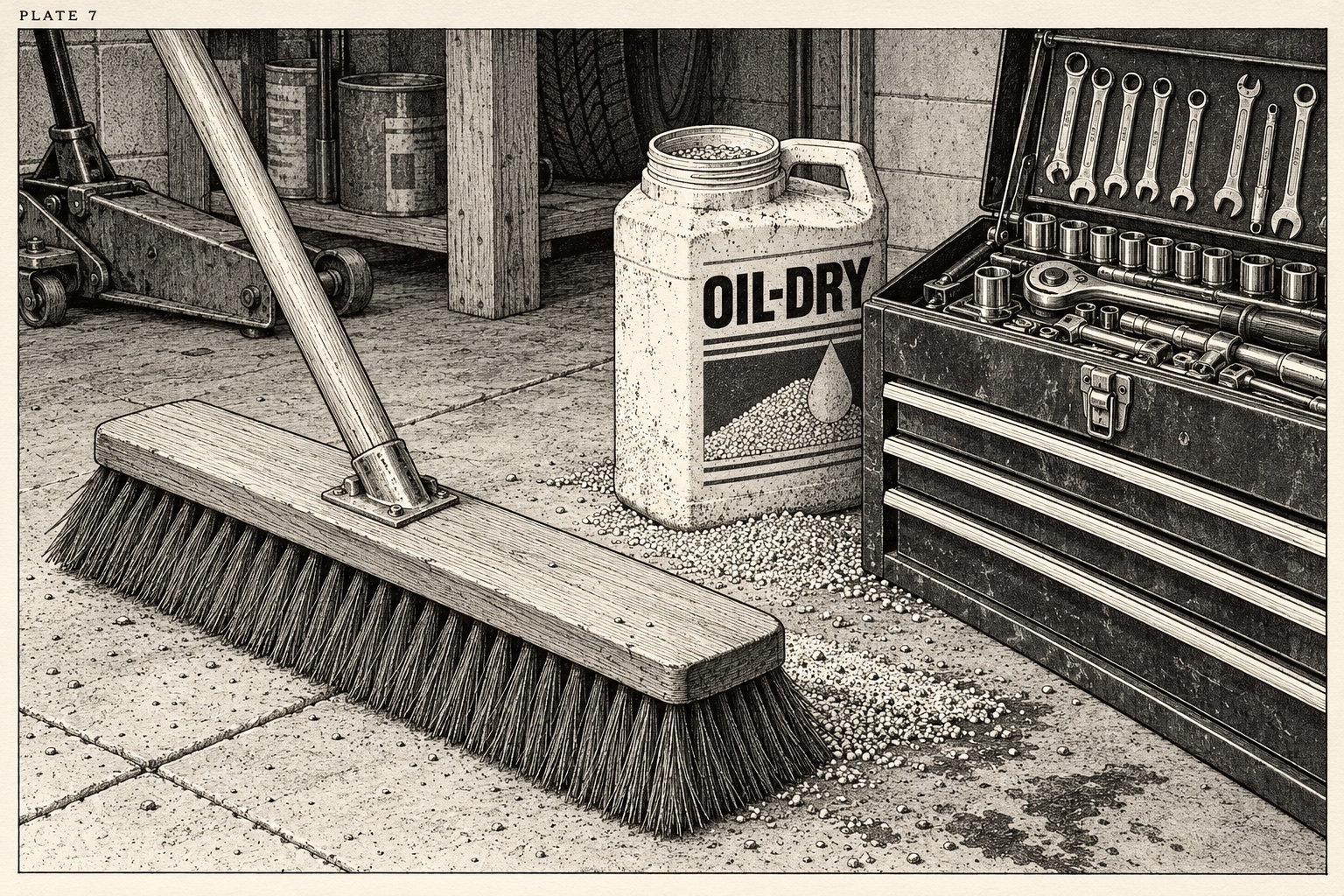
Listen to the physics of what happened over the next fifteen minutes. Bristles of stiff palmyra fiber moved in rhythmic, overlapping strokes across scored gray concrete. Granules of fuller’s earth soaked with dark 90-weight gear oil, dried mud knocked from ranch truck fenders, and rusted cotter pins rolled ahead of the brush in a neat, advancing crescent toward the sunny threshold of the bay door. Ten feet away, the mechanic bent back over the open hood of a Ford sedan, adjusting the idle-mixture screw on a two-barrel carburetor while the engine ticked and purred.
Nothing mystical was announced. No chakras blazed with technicolor fireworks; no voices spoke from the clouds. There was only the dry shhh-shhh of the broom bristles, the smell of hot manifold iron and unburned hydrocarbons, the sweat cooling on the chemist’s ribs in the draft of the bay, and the quiet concentration of two men attending to the maintenance of a concrete room and an internal combustion engine.
Yet as the chemist swept the pile of dust into the dustpan and emptied it into the fifty-gallon drum outside, he felt a sudden, overwhelming loosening in his chest. The exchange was vastly larger than the bargain.
Why was it larger than a mere commercial bargain? Because in a conventional egoic bargain, two Imaginary Proprietors stand behind armed barricades calculating how to extract maximum value while giving minimum self: "I will give you twelve cents worth of stale bread to extract twenty-five cents worth of sweeping." Here, no one was keeping a defensive ledger. The mechanic had bread; the floor needed sweeping; the traveler had legs and arms and hunger; the afternoon held room for all of it. By picking up the broom, the chemist was no longer a spiritual tourist demanding a free ride from the cosmos; he had superinserted his own muscular labor directly back into the toroidal loop that was feeding him!
Recall our energetic balance equation from Chapter 2:
When the traveler receives bread () and returns useful order to the workshop floor (), the circuit closes cleanly without resentment, debt, or spiritual inflation. The broom was not the compromise of his awakening; the broom was the exact instrument by which he re-entered the undivided world.
3.6 Law Versus Dependence: The Louisiana Realization
In late June of 1972, his canvas rucksack bleached nearly white by the sun and his boots resoled once with pieces of cut tire tread in East Texas, the chemist walked down Canal Street in New Orleans to the levee of the Mississippi River.
Watching the immense brown current of the river—carrying the topsoil of thirty-one states and two Canadian provinces down toward the Gulf in swirling, linked Karman vortex streets—he sat on the timber pilings and opened his battered pocket notebook to write the final summary of the 1972 Field Experiment.
What had two thousand miles of asphalt, concrete culverts, ranch porches, and garage floors actually proven?
First, by the time he reached Louisiana, he no longer believed that the road had proved a metaphysical "law of cosmic protection."
Let us dwell upon the vital distinction between a law of cosmic protection and the fact of universal dependence, for this distinction separates mature non-dual philosophy from dangerous magical thinking.
In the popular New Age literature of the 1970s, one constantly encounters the claim that "if you vibrate at a high enough spiritual frequency and release fear, a cosmic law guarantees that money, food, and parking spaces will materialize effortlessly at your feet." Not only is that claim empirically false—as any honest observer of history, famine, and physical contingency knows—it is also spiritually poisonous. Why? Because a "law" would have entitled him to assistance.
If you believe that a cosmic law guarantees your provision because you have achieved an exalted state of ego-surrender, then:
1. You secretly install yourself as a privileged aristocrat of the cosmos whose survival proves your spiritual superiority;
2. By logical contrapositive, you must conclude that anyone who goes hungry, suffers an injury, or fails in a venture simply "lacked sufficient consciousness"; and
3. When a stranger hands you a loaf of bread, you do not truly see or thank the stranger—you treat her as a mere vending-machine lever pulled by the Cosmic Law on your behalf!
Dependence, by contrast, required him to notice it.
The road had not proven that the universe owed him a living. It had shown him, bone-deep and beyond argument, how little of his continued existence belonged to him alone. His breath belonged to the photosynthetic marine phytoplankton of the Gulf and the pine forests of East Texas. His water belonged to the hydrological cycle and the municipal pipe-fitters. His safety in the culverts belonged to the highway engineers. His nutrition belonged to the mechanic with the push-broom and the fifty anonymous men and women who had paused along two thousand miles of pavement to share a sandwich, a ride across a flooded wash, or a dry barn floor.
When you give up the fantasy of a "cosmic law of entitlement" and wake up inside the sheer, unbuffered contingency of dependent arising (pratītyasamutpāda), two things happen simultaneously in the heart:
First, the exhausting tension of the isolated proprietor (svabhāva) drops away—not because a magical force-field prevents you from ever getting a blister, but because you realize there was never an isolated "you" locked inside your skin having to carry the universe on your private shoulders in the first place.
Second, an immense, unsentimental tenderness and gratitude toward ordinary human arrangements awakens. You stop sneering at the grocer, the accountant, the highway crew, and the laboratory technician as "unenlightened cogs in the matrix," because you have seen with your own eyes that they are your own externalized organs.
That evening in a cheap boardinghouse room off Royal Street, before taking a summer job washing laboratory glassware at a marine testing station to earn his train fare back to California, the chemist wrote a letter to his closest friend back at the university. His friend had expected a triumphant proclamation that the pilgrim had conquered mortal fear and transcended the need for human society. Instead, the chemist omitted all mention of enlightenment and wrote two plain sentences that could serve as a footnote to Gregory Bateson’s cybernetics:
"I have become less certain where my equipment ends. Some of it has names and families."
3.7 Systems Analysis of the 1972 Walk: Toroidal Reciprocity
Let us step back to the blackboard for a moment and map the three developmental stages of the 1972 Field Experiment onto our cybernetic and supertoroidal coordinate system:
| Stage of the 1972 Field Experiment | Assumed Boundary of the Self | View of Conventional Arrangements (Saṃvṛti) | Cybernetic & Field Dynamic Status |
|---|---|---|---|
| Phase I: Pre-Walk Urban Anxiety | Skin-encapsulated ego () defending private svabhāva. | Seen as a hostile arena of scarcity requiring constant hoarding and control. | High resistive turbulence (); cross-field Lorentz stress (). |
| Phase II: First 100 Miles (Romantic Renunciation) | "Enlightened Pilgrim" testing a private contract with the Cosmic Absolute. | Disdained as beneath the seeker; expected to provide unconditionally without reciprocity. | Open-loop delusion (); subtle egoic demand masquerading as surrender. |
| Phase III: Culvert, Broom, and Louisiana (Non-Dual Integration) | Extended Batesonian circuit across organism, road, tools, and other people. | Recognized as the empty, dependently arisen medium of mutual care and exchange. | Closed supertoroidal reciprocity; force-free alignment () without entitlement. |
Look at how the trajectory from California to New Orleans and back completes a grand toroidal turn () that permanently alters the poloidal cross-section () of the practitioner’s understanding.
He walked out of California thinking that to hold the universe concise inside, he had to flee the marketplace outside. He returned from Louisiana knowing that the highway culvert and the corporate laboratory are made of the exact same dependent concrete, and that sweeping a mechanic’s floor in exchange for half a loaf of bread is already the fundamental equation of honorable commerce.
Yet a crucial question remained unanswered when the chemist stepped off the train back in California. Sweeping a garage floor with a push-broom is a simple, first-order mechanical exchange. What happens when the work you are called to perform is not sweeping dust, but operating at the highest levels of abstract molecular invention—synthesizing complex catalytic architectures at the frontier of biochemistry? Can a mind resting in non-dual stillness generate cutting-edge scientific designs without falling back into the arrogance of the "visionary creator"?
Three years after the New Orleans walk, in the autumn of 1975, that question was put to the test in a highway motel room at the edge of the western desert.
<!-- PASTE BATCH 2 (INSTALLMENTS 4 & 5) BELOW THIS LINE -->
Chapter companion
Chapter 3 leaves the chalkboard behind for two thousand miles of asphalt between California and New Orleans. In the story of the twenty-six-year-old chemist sheltering in a concrete drainage culvert and sweeping a garage bay in Pecos County for half a loaf of bread, our tradition finds one of its dearest parables: nobody walks alone, and the humblest act of reciprocity closes a living circle.
Core teachings
- Even our most determined attempts at solitary independence rely on roads, water pipes, and the unseen labor of strangers.
- A concrete highway culvert is not empty wilderness; it is civic care poured into steel and cement.
- Receiving bread when hungry and sweeping a dusty floor with the broom in your hand are two halves of one relationship.
- Calling a neighbor’s generosity a cosmic law of karma risks turning a living human being into a clerk of the universe.
- Real gratitude shows itself by leaving the floor walkable and the broom where the next person can reach it.
In ordinary life
When we travel, recover from an illness, or finish a hard project, it is easy to tell the story as a solo triumph. Chapter 3 invites us to stop and name the county crews, the night-shift workers, and the ordinary kindnesses that actually carried us across.
Where to test this
Stories of solitary travelers walking through rural towns can easily treat local working people as mere backdrops for a seeker’s awakening. We read the Pecos County episode with respect for the station owner’s ordinary work, and our companion story in the Return Papers brings that humility to the foreground.
Sources and scope
Chapter 3 is the book’s narrative parable; “The Road That Carried Him” and “Bread and the Returning Hand” in our Return Papers expand those days in our tradition’s storytelling voice.
Questions for reflection
- What infrastructure or unseen labor held your day together before you even ate breakfast?
- Why is it important not to turn an ordinary act of mutual aid into a grand metaphysical debt?
- Where in your life right now is a broom already in your hand?